How to use this calculator
Compare fluid inertia with surface tension using density, velocity, characteristic length, and interfacial tension.
- Enter Fluid density ρ (kg/m³), Characteristic velocity U (m/s), Characteristic length L (m), Surface tension σ (N/m). Match the units shown beside each field and review the result together with the assumptions below.
- Read the worked example below to check the expected input format and result.
- Compare another scenario by changing one input at a time. Use Reset to return to the starting values.
How this calculation works
The Weber number is a dimensionless comparison between inertial effects and surface tension at a fluid interface. It is used in problems involving droplets, jets, bubbles, and thin liquid films. A higher value indicates that inertia is stronger relative to surface tension for the selected velocity and length scale.
Inputs and units
density— Fluid density ρ (kg/m³)- Density of the moving fluid at the operating condition.
velocity— Characteristic velocity U (m/s)- Representative speed associated with the interface or flow feature.
length— Characteristic length L (m)- Representative drop diameter, jet width, or other relevant length scale.
tension— Surface tension σ (N/m)- Interfacial surface tension for the fluid pair and temperature.
Formula
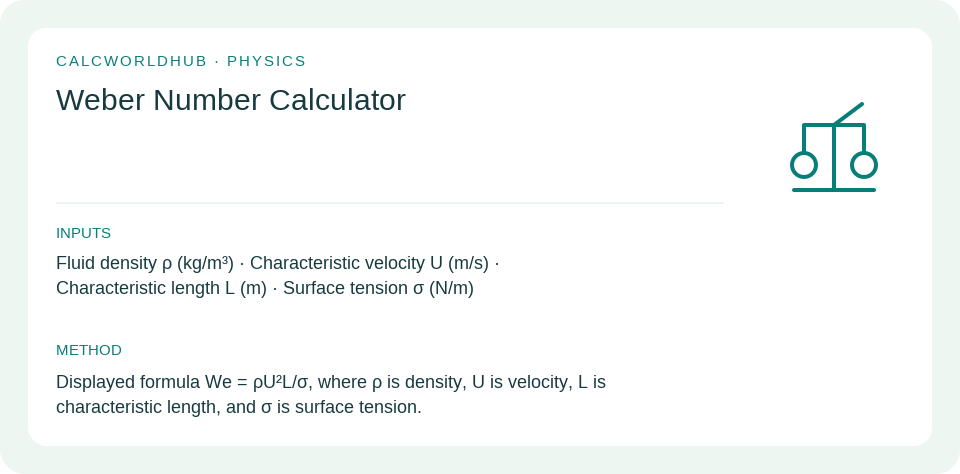
We = ρU²L/σ, where ρ is density, U is velocity, L is characteristic length, and σ is surface tension.
Method
Multiply density by the square of the characteristic speed and by the length scale, then divide by surface tension. In SI units, kg/m³ × (m/s)² × m and N/m reduce to the same dimensions.
Worked example
For water-like density 1,000 kg/m³, speed 2 m/s, length 0.010 m, and surface tension 0.072 N/m, We = 555.556.
Assumptions and limits
Choose a characteristic length and velocity that match the physical interface being analyzed. This ratio alone does not predict breakup or flow regime; those outcomes also depend on geometry, viscosity, boundary conditions, and other dimensionless groups.
Frequently asked questions
What does a high Weber number indicate?
It indicates that inertial effects are large compared with surface tension at the chosen velocity and length scale.
Which length should I use?
Use the characteristic dimension governing the interface, such as a droplet diameter or jet width, and state that choice when comparing results.
Is Weber number enough to predict droplet breakup?
No. It is one similarity parameter. Viscosity, geometry, turbulence, and the exact flow configuration can also matter.
How do I use the Weber Number Calculator?
Enter Fluid density ρ (kg/m³), Characteristic velocity U (m/s), Characteristic length L (m), Surface tension σ (N/m). Match the units shown beside each field and review the result together with the assumptions below.
What is a worked example of Weber Number?
For water-like density 1,000 kg/m³, speed 2 m/s, length 0.010 m, and surface tension 0.072 N/m, We = 555.556.
Reference: technical reference. See our calculation methodology.