How to use this calculator
Compare viscous forces with interfacial surface tension using the capillary number for a moving fluid.
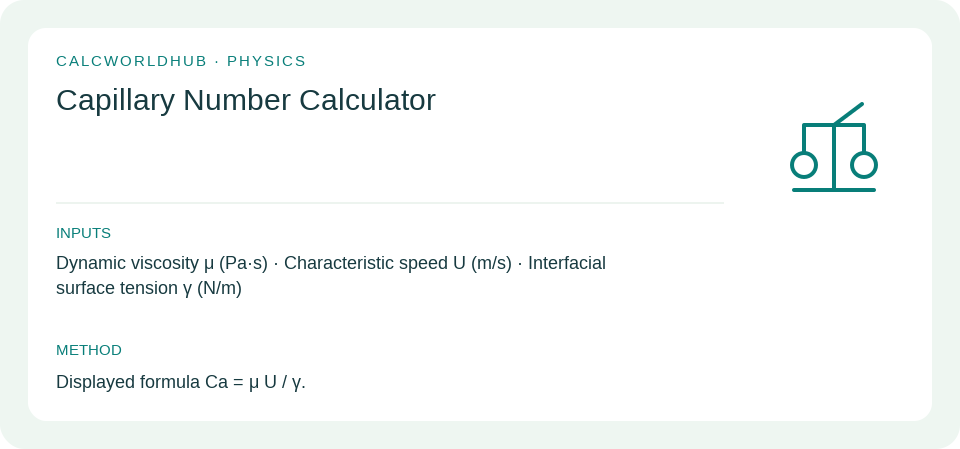
- Enter Dynamic viscosity μ (Pa·s), Characteristic speed U (m/s), Interfacial surface tension γ (N/m). Match the units shown beside each field and review the result together with the assumptions below.
- Read the worked example below to check the expected input format and result.
- Compare another scenario by changing one input at a time. Use Reset to return to the starting values.
How this calculation works
The capillary number is a dimensionless ratio of viscous stresses to interfacial surface tension. It is calculated from dynamic viscosity, characteristic speed, and surface tension. The result is specific to the selected velocity scale and interface; it is not a direct prediction of droplet breakup or displacement without a matching physical model.
Inputs and units
viscosity— Dynamic viscosity μ (Pa·s)- Enter dynamic viscosity, not kinematic viscosity.
velocity— Characteristic speed U (m/s)- Enter a nonnegative characteristic fluid speed.
surfaceTension— Interfacial surface tension γ (N/m)- Use the tension at the interface being studied.
Formula
Ca = μ U / γ.
Method
Multiply dynamic viscosity μ in Pa·s by characteristic speed U in m/s, then divide by interfacial tension γ in N/m.
Worked example
For μ = 0.001 Pa·s, U = 0.10 m/s, and γ = 0.072 N/m, Ca = 0.00139.
Assumptions and limits
The value depends on the interface, velocity scale, and flow configuration. It does not replace a geometry-specific stability or breakup model.
Frequently asked questions
What does the capillary number compare?
It compares viscous stresses with interfacial surface tension for the entered fluid speed and interface.
What viscosity should I enter?
Enter dynamic viscosity in pascal-seconds. Kinematic viscosity has units of square metres per second and is a different property.
Does a capillary number predict droplet breakup?
Not on its own. Breakup thresholds depend on geometry, viscosity ratio, flow type, and other conditions.
How do I use the Capillary Number Calculator?
Enter Dynamic viscosity μ (Pa·s), Characteristic speed U (m/s), Interfacial surface tension γ (N/m). Match the units shown beside each field and review the result together with the assumptions below.
What is a worked example of Capillary Number?
For μ = 0.001 Pa·s, U = 0.10 m/s, and γ = 0.072 N/m, Ca = 0.00139.
Reference: technical reference. See our calculation methodology.