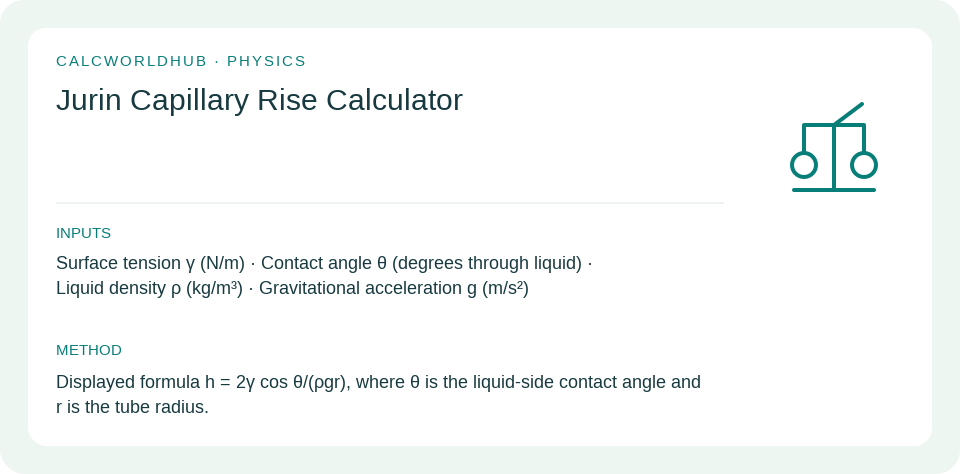
How to use this calculator
Estimate the signed equilibrium rise or depression of a liquid in a narrow cylindrical capillary.
- Enter Surface tension γ (N/m), Contact angle θ (degrees through liquid), Liquid density ρ (kg/m³), Gravitational acceleration g (m/s²), then complete the remaining labeled fields. Match the units shown beside each field and review the result together with the assumptions below.
- Read the worked example below to check the expected input format and result.
- Compare another scenario by changing one input at a time. Use Reset to return to the starting values.
How this calculation works
Jurin's law balances the hydrostatic weight of a liquid column against the vertical component of surface tension along the tube perimeter. The contact angle is measured through the liquid. A wetting liquid can rise above the outside level, while a nonwetting liquid with a contact angle above 90° can be depressed.
Inputs and units
gamma— Surface tension γ (N/m)- Liquid–gas surface tension at the temperature of interest.
theta— Contact angle θ (degrees through liquid)- Liquid-side contact angle measured through the liquid, from 0° to 180°.
rho— Liquid density ρ (kg/m³)- Density of the liquid in the capillary.
g— Gravitational acceleration g (m/s²)- Local gravitational acceleration.
radius— Inside tube radius r (mm)- Capillary inside radius, not diameter, in millimeters.
Formula
h = 2γ cos θ/(ρgr), where θ is the liquid-side contact angle and r is the tube radius.
Method
Convert the radius from millimeters to meters, evaluate the cosine of the entered contact angle in degrees, and divide twice the surface tension by density, gravity, and radius. The sign of h is retained.
Worked example
With γ = 0.072 N/m, θ = 0°, ρ = 1,000 kg/m³, g = 9.80665 m/s², and r = 0.5 mm, Jurin's law predicts a 29.368 mm rise.
Assumptions and limits
This static relation assumes a clean cylindrical tube, a defined liquid-side contact angle, uniform density and surface tension, and a tube radius small compared with the capillary length. It does not model contact-angle hysteresis or transient motion.
Frequently asked questions
Can the result be negative?
Yes. A liquid-side contact angle above 90° makes cos θ negative, so the equilibrium level is depressed below the surrounding liquid.
Should I enter the tube diameter or radius?
Enter the inside radius. If you measured the diameter, divide it by two first.
When is this capillary-height estimate unreliable?
The static cylindrical-tube relation is less suitable when the tube is not narrow relative to the capillary length or when contact angle, surface tension, or geometry changes along the tube.
How do I use the Jurin Capillary Rise Calculator?
Enter Surface tension γ (N/m), Contact angle θ (degrees through liquid), Liquid density ρ (kg/m³), Gravitational acceleration g (m/s²), then complete the remaining labeled fields. Match the units shown beside each field and review the result together with the assumptions below.
What is a worked example of Jurin Capillary Rise?
With γ = 0.072 N/m, θ = 0°, ρ = 1,000 kg/m³, g = 9.80665 m/s², and r = 0.5 mm, Jurin's law predicts a 29.368 mm rise.
Reference: École Nationale Supérieure de Chimie de Rennes surface-tension and capillary-rise reference. See our calculation methodology.