How to use this calculator
Estimate first-order optical pulse broadening from fiber dispersion, fiber length, and source spectral width.
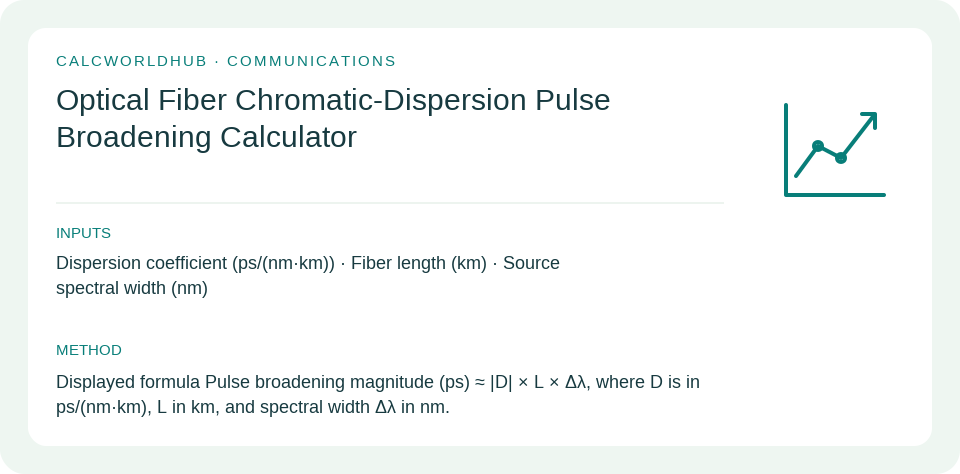
- Enter Dispersion coefficient (ps/(nm·km)), Fiber length (km), Source spectral width (nm). Match the units shown beside each field and review the result together with the assumptions below.
- Read the worked example below to check the expected input format and result.
- Compare another scenario by changing one input at a time. Use Reset to return to the starting values.
How this calculation works
Enter the chromatic-dispersion coefficient at the operating wavelength, fiber length, and source spectral width. The calculator reports the magnitude of first-order pulse-width spread.
Inputs and units
dispersionPsNmKm— Dispersion coefficient (ps/(nm·km))- Chromatic-dispersion coefficient at the operating wavelength; sign is allowed.
fiberLengthKm— Fiber length (km)- Optical path length.
spectralWidthNm— Source spectral width (nm)- Spectral width using the convention associated with the selected coefficient/model.
Formula
Pulse broadening magnitude (ps) ≈ |D| × L × Δλ, where D is in ps/(nm·km), L in km, and spectral width Δλ in nm.
Method
Multiply the absolute dispersion coefficient by fiber length and source spectral width. The units reduce directly to picoseconds.
Worked example
For |D| = 17 ps/(nm·km), 80 km of fiber, and 0.10 nm spectral width, estimated broadening is 136 ps.
Assumptions and limits
This linear estimate ignores pulse chirp, dispersion slope across the source spectrum, polarization-mode dispersion, nonlinear effects, and receiver filtering. Use a consistent spectral-width convention and applicable system-design analysis.
Frequently asked questions
Why use absolute dispersion?
This output reports broadening magnitude; the dispersion sign indicates wavelength-dependent delay direction.
Does this include pulse chirp?
No. Chirp and higher-order dispersion may alter the pulse shape and width.
Which spectral-width definition should I use?
Use a width convention consistent with the coefficient and system model, such as the specified RMS or FWHM width.
How do I use the Optical Fiber Chromatic-Dispersion Pulse Broadening Calculator?
Enter Dispersion coefficient (ps/(nm·km)), Fiber length (km), Source spectral width (nm). Match the units shown beside each field and review the result together with the assumptions below.
What is a worked example of Optical Fiber Chromatic-Dispersion Pulse Broadening?
For |D| = 17 ps/(nm·km), 80 km of fiber, and 0.10 nm spectral width, estimated broadening is 136 ps.
Reference: ITU-T G Supplement 39 optical-system chromatic-dispersion design method. See our calculation methodology.