How to use this calculator
Convert monochromatic optical power into photon energy, photons per second, and area-normalized flux.
- Enter Optical power (mW), Wavelength (nm), Illuminated area (mm²). Match the units shown beside each field and review the result together with the assumptions below.
- Read the worked example below to check the expected input format and result.
- Compare another scenario by changing one input at a time. Use Reset to return to the starting values.
How this calculation works
Each photon at wavelength λ carries energy hc/λ. Dividing optical power by that energy gives the photon rate. If the beam area is known, dividing by area gives an average photon flux density; this assumes the entered power is concentrated at one wavelength.
Inputs and units
power— Optical power (mW)- Power measured at the plane where photon rate is needed.
wavelength— Wavelength (nm)- Monochromatic vacuum wavelength in nanometres.
area— Illuminated area (mm²)- Area over which to average photon flux density.
Formula
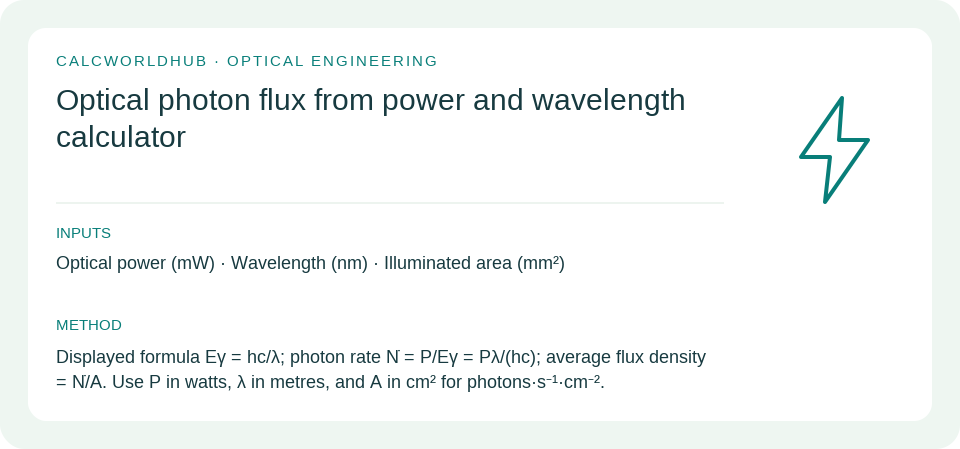
Eγ = hc/λ; photon rate Ṅ = P/Eγ = Pλ/(hc); average flux density = Ṅ/A. Use P in watts, λ in metres, and A in cm² for photons·s⁻¹·cm⁻².
Method
Enter optical power in milliwatts, wavelength in nanometres, and illuminated area in square millimetres. The calculator converts units internally and reports energy per photon, photons per second, and average flux per square centimetre.
Worked example
At 1 mW and 532 nm, each photon carries about 3.734×10⁻¹⁹ J, giving roughly 2.678×10¹⁵ photons/s. Over 1 mm², the area-average is about 2.678×10¹⁷ photons/(s·cm²).
Assumptions and limits
Assumes monochromatic light, steady optical power, and a uniformly averaged illuminated area. A broadband source requires spectral integration; a nonuniform beam may have local flux values different from the area average. Optical losses after the power measurement are not included.
Frequently asked questions
Why does shorter-wavelength light produce more photons at the same power?
Each shorter-wavelength photon has more energy, so a fixed optical power corresponds to fewer photons per second.
Can I use this for a broadband LED?
Only as a rough single-wavelength estimate. A broadband source needs its spectral power distribution integrated over wavelength.
What area unit should I enter?
Enter the illuminated area in square millimetres; the result is converted to square centimetres for flux density.
Does the result include optical losses?
No. Use power measured at the location of interest or account for intervening losses separately.
How do I use the Optical photon flux from power and wavelength calculator?
Enter Optical power (mW), Wavelength (nm), Illuminated area (mm²). Match the units shown beside each field and review the result together with the assumptions below.
Reference: NIST optical-radiation measurement note on photon energy and flux. See our calculation methodology.