How to use this calculator
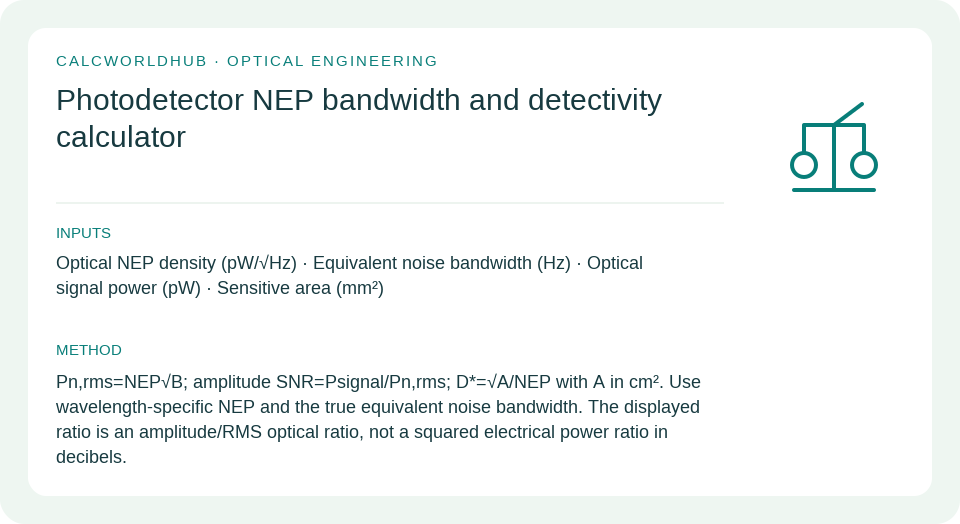
Translate a detector white-noise specification into the optical noise of a measurement bandwidth and area-normalized detectivity.
- Enter Optical NEP density (pW/√Hz), Equivalent noise bandwidth (Hz), Optical signal power (pW), Sensitive area (mm²). Match the units shown beside each field and review the result together with the assumptions below.
- Read the worked example below to check the expected input format and result.
- Compare another scenario by changing one input at a time. Use Reset to return to the starting values.
Photodetector NEP bandwidth and detectivity explained
Inputs, symbols, and units
nep— Optical NEP density (pW/√Hz)- Input-referred white optical noise density at the operating wavelength.
bandwidth— Equivalent noise bandwidth (Hz)- Integrated noise bandwidth, not automatically the minus-three-dB bandwidth.
power— Optical signal power (pW)- Signal power expressed with the same RMS convention as the noise.
area— Sensitive area (mm²)- Physical active detector area for specific detectivity.
Formula and method
Pn,rms=NEP√B; amplitude SNR=Psignal/Pn,rms; D*=√A/NEP with A in cm².
Use wavelength-specific NEP and the true equivalent noise bandwidth. The displayed ratio is an amplitude/RMS optical ratio, not a squared electrical power ratio in decibels.
A worked scenario
Optical NEP density (pW/√Hz) = 1; Equivalent noise bandwidth (Hz) = 100; Optical signal power (pW) = 100; Sensitive area (mm²) = 1.
- Equivalent RMS optical noise: 10 pW
- Signal amplitude to RMS noise ratio: 10
- Specific detectivity: 100000000000 cm √Hz/W
NEP 1 pW/√Hz in 100 Hz gives 10 pW RMS equivalent optical noise; a 100 pW signal is ten times this noise.
Assumptions and edge cases
White detector noise over the whole specified band. Signal shot noise, one-over-f noise, modulation response and saturation are not included.
Reading the outputs
Noise is pW, the ratio is dimensionless and D-star uses cm√Hz/W.
Frequently asked questions
Can I use detector bandwidth as noise bandwidth?
Only for an ideal rectangular response; real filters need an integrated equivalent bandwidth.
Does increasing detector area always improve sensitivity?
No. D-star normalizes area but electronics and capacitance can change actual NEP.
Why must wavelength match the NEP specification?
Responsivity changes with wavelength and therefore changes input-referred optical noise.
How do I use the Photodetector NEP bandwidth and detectivity calculator?
Enter Optical NEP density (pW/√Hz), Equivalent noise bandwidth (Hz), Optical signal power (pW), Sensitive area (mm²). Match the units shown beside each field and review the result together with the assumptions below.
What is a worked example of Photodetector NEP bandwidth and detectivity?
Optical NEP density (pW/√Hz) = 1; Equivalent noise bandwidth (Hz) = 100; Optical signal power (pW) = 100; Sensitive area (mm²) = 1. Equivalent RMS optical noise: 10 pW Signal amplitude to RMS noise ratio: 10 Specific detectivity: 100000000000 cm √Hz/W NEP 1 pW/√Hz in 100 Hz gives 10 pW RMS equivalent optical noise; a 100 pW signal is ten times this noise.
Background or definition reference: Thorlabs noise equivalent power technical white paper.
Read our calculation methodology.