How to use this calculator
Estimate horizontal stress for a restrained soil element using an explicit empirical overconsolidation adjustment.
- Enter Effective vertical stress (kPa), Effective friction angle (degrees), Overconsolidation ratio, Pore pressure (kPa). Match the units shown beside each field and review the result together with the assumptions below.
- Read the worked example below to check the expected input format and result.
- Compare another scenario by changing one input at a time. Use Reset to return to the starting values.
Overconsolidated soil at rest lateral stress explained
Estimate at-rest lateral stress using vertical effective stress, friction angle, overconsolidation ratio and local pore pressure.
How the calculation works
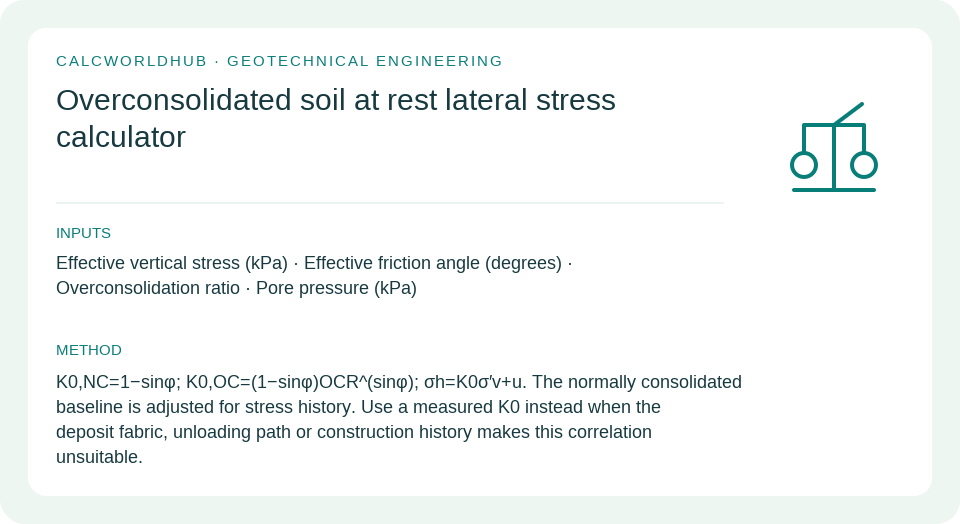
K0,NC=1−sinφ; K0,OC=(1−sinφ)OCR^(sinφ); σh=K0σ′v+u.
The normally consolidated baseline is adjusted for stress history. Use a measured K0 instead when the deposit fabric, unloading path or construction history makes this correlation unsuitable.
Set up the calculation
sv— Effective vertical stress (kPa)- Effective overburden at the point being evaluated.
phi— Effective friction angle (degrees)- Friction angle used in the empirical Jaky/overconsolidation correlation.
OCR— Overconsolidation ratio- Maximum past effective stress divided by present effective vertical stress.
u— Pore pressure (kPa)- Local positive pore pressure, added to effective horizontal stress.
Limits of this model
Empirical correlation for suitable soils; it is not a universal constitutive law and does not mobilize active or passive failure states. Educational model; this is not a code-compliant design check.
Check this example
Effective vertical stress (kPa) = 100; Effective friction angle (degrees) = 30; Overconsolidation ratio = 2; Pore pressure (kPa) = 25.
- Total horizontal stress: 95.710678 kPa
- At-rest coefficient: 0.707107
- Effective horizontal stress: 70.710678 kPa
At 100 kPa vertical effective stress, φ=30° and OCR=2, the correlation gives K0≈0.7071. Adding 25 kPa pore pressure gives about 95.71 kPa total horizontal stress.
Reading the outputs
Total and effective horizontal stresses are kPa; K0 expresses the effective horizontal-to-vertical stress ratio.
Frequently asked questions
Can K0 exceed one?
Yes, the empirical OCR correction can yield horizontal effective stress above vertical stress after substantial unloading.
Why is OCR below one rejected?
The chosen overconsolidation model assumes a normally consolidated or overconsolidated state.
Does pore pressure change K0?
It is added after the effective-stress correlation; it does not enter the coefficient directly.
How do I use the Overconsolidated soil at rest lateral stress calculator?
Enter Effective vertical stress (kPa), Effective friction angle (degrees), Overconsolidation ratio, Pore pressure (kPa). Match the units shown beside each field and review the result together with the assumptions below.
What is a worked example of Overconsolidated soil at rest lateral stress?
Effective vertical stress (kPa) = 100; Effective friction angle (degrees) = 30; Overconsolidation ratio = 2; Pore pressure (kPa) = 25. Total horizontal stress: 95.710678 kPa At-rest coefficient: 0.707107 Effective horizontal stress: 70.710678 kPa At 100 kPa vertical effective stress, φ=30° and OCR=2, the correlation gives K0≈0.7071. Adding 25 kPa pore pressure gives about 95.71 kPa total horizontal stress.
Background or definition reference: FHWA Soils and Foundations Reference Manual, Volume I.