How to use this calculator
Estimate the area-weighted U-value and heat flow through a wall with two parallel thermal paths.
- Enter Total wall area (m²), Indoor-outdoor temperature difference (K), Area fraction of path 1 (%), Path 1 U-value (W/m²·K), then complete the remaining labeled fields. Match the units shown beside each field and review the result together with the assumptions below.
- Read the worked example below to check the expected input format and result.
- Compare another scenario by changing one input at a time. Use Reset to return to the starting values.
How this calculation works
A wall can lose heat through continuous insulation and through framing or other repeating bridges. Enter the area share and U-value for each path plus total wall area and temperature difference to estimate the combined heat-transfer coefficient and rate.
Inputs and units
area— Total wall area (m²)- Gross area represented by the two parallel paths.
delta— Indoor-outdoor temperature difference (K)- Temperature difference magnitude in kelvins.
fraction— Area fraction of path 1 (%)- Percentage of total area occupied by path 1.
u1— Path 1 U-value (W/m²·K)- Thermal transmittance for the first path.
u2— Path 2 U-value (W/m²·K)- Thermal transmittance for the second path.
Formula
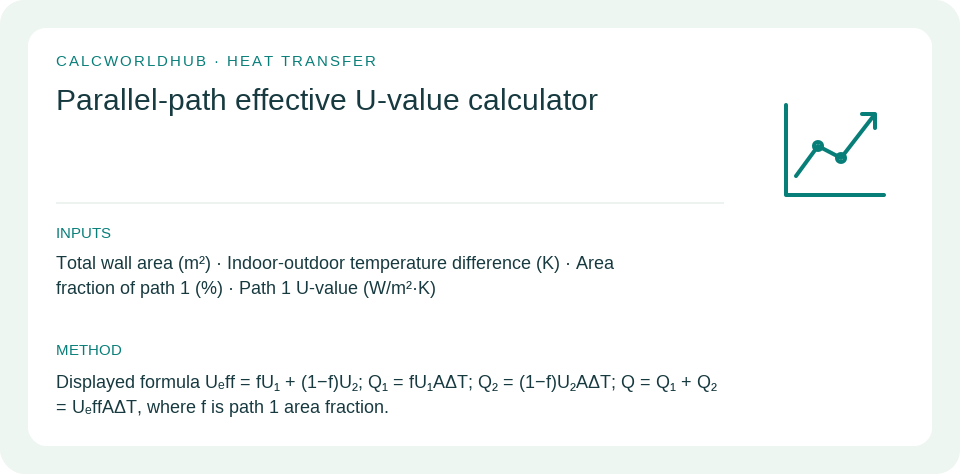
Uₑff = fU₁ + (1−f)U₂; Q₁ = fU₁AΔT; Q₂ = (1−f)U₂AΔT; Q = Q₁ + Q₂ = UₑffAΔT, where f is path 1 area fraction.
Method
The two path areas act in parallel, so their heat flows add. Each path contributes UᵢAᵢΔT; dividing the total by wall area and temperature difference gives the effective U-value.
Worked example
For a 30 m² wall with an 80% path at U=0.4 W/m²·K, a 20% bridge path at U=1.6 W/m²·K, and ΔT=20 K, Ueff=0.64 W/m²·K and heat flow is 384 W.
Assumptions and limits
This steady one-dimensional estimate assumes two uniform paths exposed to the same temperature difference. It omits junction effects, air leakage, moisture, transient storage, surface-film detail beyond the entered U-values, and multidimensional heat flow.
Frequently asked questions
Why is the effective U-value an area-weighted average?
The parallel paths have the same temperature difference, so each path’s heat flow is proportional to its area and U-value.
Does this model a stud wall accurately?
Only as a simplified two-path estimate. Real framing layouts include repeated geometry, junctions, fasteners, and multidimensional heat flow.
Can I enter an R-value instead?
Convert each path to U=1/R using consistent area-normalized units before entering it.
How do I use the Parallel-path effective U-value calculator?
Enter Total wall area (m²), Indoor-outdoor temperature difference (K), Area fraction of path 1 (%), Path 1 U-value (W/m²·K), then complete the remaining labeled fields. Match the units shown beside each field and review the result together with the assumptions below.
What is a worked example of Parallel-path effective U-value?
For a 30 m² wall with an 80% path at U=0.4 W/m²·K, a 20% bridge path at U=1.6 W/m²·K, and ΔT=20 K, Ueff=0.64 W/m²·K and heat flow is 384 W.
Reference: U.S. DOE Building Science Education guidance on parallel heat-flow paths. See our calculation methodology.