How to use this calculator
Compare a small spherical particle’s response time with a selected fluid-flow time scale.
- Enter Particle density, Particle diameter, Fluid dynamic viscosity, Characteristic flow speed, then complete the remaining labeled fields. Match the units shown beside each field and review the result together with the assumptions below.
- Read the worked example below to check the expected input format and result.
- Compare another scenario by changing one input at a time. Use Reset to return to the starting values.
How this calculation works
The Stokes number is a dimensionless comparison between how quickly a particle reacts to changes and how quickly the surrounding flow changes. This calculator estimates the particle relaxation time for a sphere in the low-Reynolds-number Stokes-drag regime, then compares it with a characteristic travel time selected from a flow length and speed.
Inputs and units
particleDensity— Particle density- Particle material density in kilograms per cubic meter (kg/m³).
diameter— Particle diameter- Spherical particle diameter in meters (m), not radius.
viscosity— Fluid dynamic viscosity- Dynamic viscosity in pascal-seconds (Pa·s).
flowVelocity— Characteristic flow speed- Representative fluid speed in meters per second (m/s).
flowLength— Characteristic flow length- Length scale over which the flow changes, in meters (m).
Formula
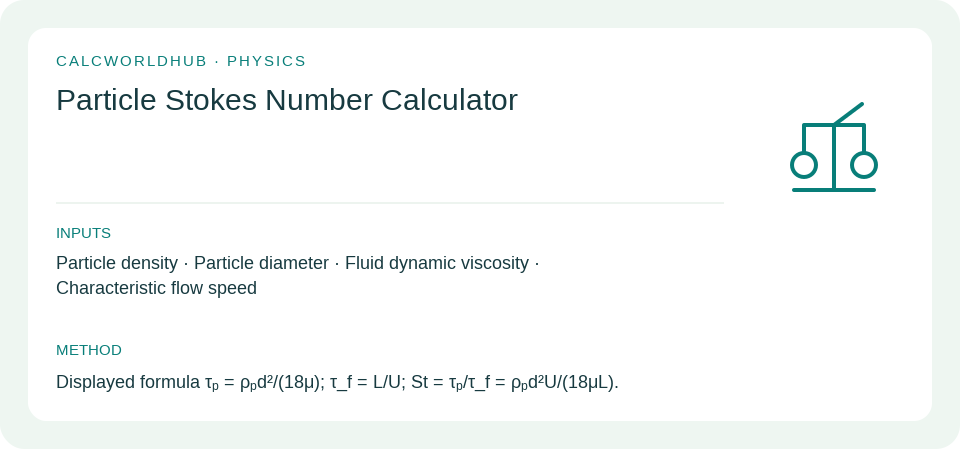
τₚ = ρₚd²/(18μ); τ_f = L/U; St = τₚ/τ_f = ρₚd²U/(18μL).
Method
Use SI units: particle density ρₚ in kg/m³, diameter d in m, dynamic viscosity μ in Pa·s, flow length L in m, and characteristic speed U in m/s. The particle response time τₚ is divided by the flow time τ_f. St has no units; smaller values mean the modeled response time is short relative to the selected flow time.
Worked example
For a 2,500 kg/m³ sphere with 20 μm diameter in a 0.001 Pa·s fluid, τₚ = 0.0000556 s. With U = 0.5 m/s and L = 0.1 m, τ_f = 0.2 s and St ≈ 0.000278.
Assumptions and limits
The particle is modeled as a small rigid sphere with Stokes drag, negligible history and lift forces, and no particle interactions. The low particle-Reynolds-number condition should be checked using the relevant particle–fluid slip speed; this calculator does not infer that slip speed. Interpretation depends on the flow time scale selected and is not a universal pass/fail threshold.
Frequently asked questions
What does a Stokes number much smaller than one suggest?
The modeled particle response time is much shorter than the flow time you entered, so the particle may follow changes in that flow more closely under the assumptions.
Which length should I use for the flow scale?
Use the length over which fluid velocity changes for the question being studied, such as a characteristic obstacle or eddy scale. The selected scale changes the result.
Does a low Stokes number prove the particle follows the flow?
No. It is one time-scale comparison. The Stokes-drag assumption, particle–fluid slip Reynolds number, geometry, and other forces also matter.
How do I use the Particle Stokes Number Calculator?
Enter Particle density, Particle diameter, Fluid dynamic viscosity, Characteristic flow speed, then complete the remaining labeled fields. Match the units shown beside each field and review the result together with the assumptions below.
What is a worked example of Particle Stokes Number?
For a 2,500 kg/m³ sphere with 20 μm diameter in a 0.001 Pa·s fluid, τₚ = 0.0000556 s. With U = 0.5 m/s and L = 0.1 m, τ_f = 0.2 s and St ≈ 0.000278.
Reference: Purdue University fluid-mechanics notes on particle Stokes number and response time. See our calculation methodology.