Payroll burden rate calculator
Compare employer add-on labor costs with base wages for the same payroll scope.
Related calculators and articles
Compare methods and explore more free tools in hr and payroll.
How to use this calculator
Compare employer add-on labor costs with base wages for the same payroll scope.
- Enter Employer add-on cost ($), Base wages ($). Match the units shown beside each field and review the result together with the assumptions below.
- Read the worked example below to check the expected input format and result.
- Compare another scenario by changing one input at a time. Use Reset to return to the starting values.
Payroll burden rate calculator
Compare employer add-on labor costs with base wages for the same payroll scope.
Inputs and units
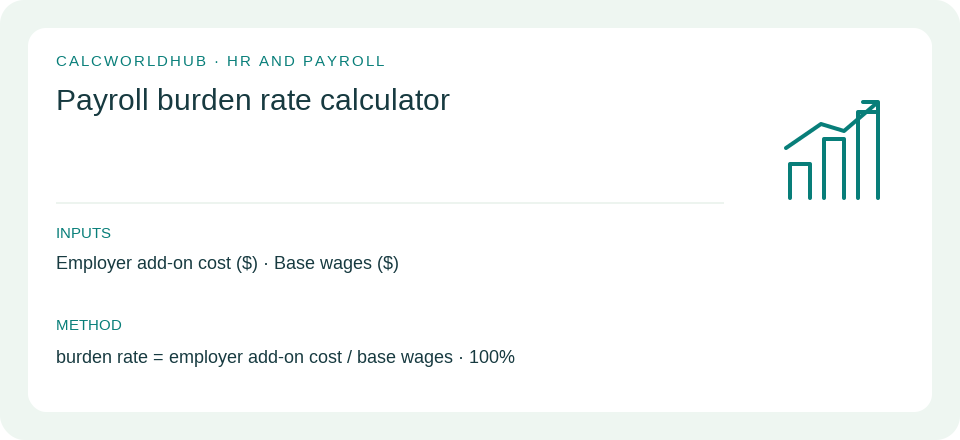
- Employer add-on cost ($): Included employer-paid costs beyond base wages, using a consistent payroll definition.
- Base wages ($): Gross base wage amount for the same workforce and period as add-on cost.
Formula and method
burden rate = employer add-on cost / base wages · 100%
Worked example
$12,500 in add-on costs on $80,000 base wages gives 15.625%.
Interpreting the result
The result depends on which taxes, benefits, insurance, and paid leave are included; it is not a universal statutory rate.
Assumptions and limits
Base wages must be positive and add-on cost nonnegative for this burden convention. Use the same workers and reporting period in numerator and denominator.
Frequently asked questions
What does this payroll burden rate result tell me?
The result depends on which taxes, benefits, insurance, and paid leave are included; it is not a universal statutory rate.
What assumptions should I check?
Base wages must be positive and add-on cost nonnegative for this burden convention. Use the same workers and reporting period in numerator and denominator.
How do I use the Payroll burden rate calculator?
Enter Employer add-on cost ($), Base wages ($). Match the units shown beside each field and review the result together with the assumptions below.
What is a worked example of Payroll burden rate?
$12,500 in add-on costs on $80,000 base wages gives 15.625%.
What does the Payroll burden rate calculator calculate?
Compare employer add-on labor costs with base wages for the same payroll scope.
See the calculation methodology.