How to use this calculator
Estimate attenuation and time delay of repeated daily or seasonal surface-temperature swings in a thick material.
- Enter Mean surface temperature (°C), Surface temperature oscillation amplitude (K), Forcing period (s), Thermal diffusivity (m²/s), then complete the remaining labeled fields. Match the units shown beside each field and review the result together with the assumptions below.
- Read the worked example below to check the expected input format and result.
- Compare another scenario by changing one input at a time. Use Reset to return to the starting values.
Periodic surface temperature penetration and phase lag explained
For a sinusoidal surface-temperature cycle, amplitude decays exponentially with depth and the temperature wave arrives later. Thermal diffusivity and period set the penetration depth, which controls both attenuation and phase lag.
Inputs, symbols, and units
mean— Mean surface temperature (°C)- Mean surface temperature (°C). Enter the value for this state; the units shown are used without an unstated conversion.
amp— Surface temperature oscillation amplitude (K)- Surface temperature oscillation amplitude (K). Enter the value for this state; the units shown are used without an unstated conversion.
period— Forcing period (s)- Forcing period (s). Enter the value for this state; the units shown are used without an unstated conversion.
alpha— Thermal diffusivity (m²/s)- Thermal diffusivity (m²/s). Enter the value for this state; the units shown are used without an unstated conversion.
x— Depth below surface (m)- Depth below surface (m). Enter the value for this state; the units shown are used without an unstated conversion.
t— Time measured from surface maximum (s)- Time measured from surface maximum (s). Enter the value for this state; the units shown are used without an unstated conversion.
Formula and method
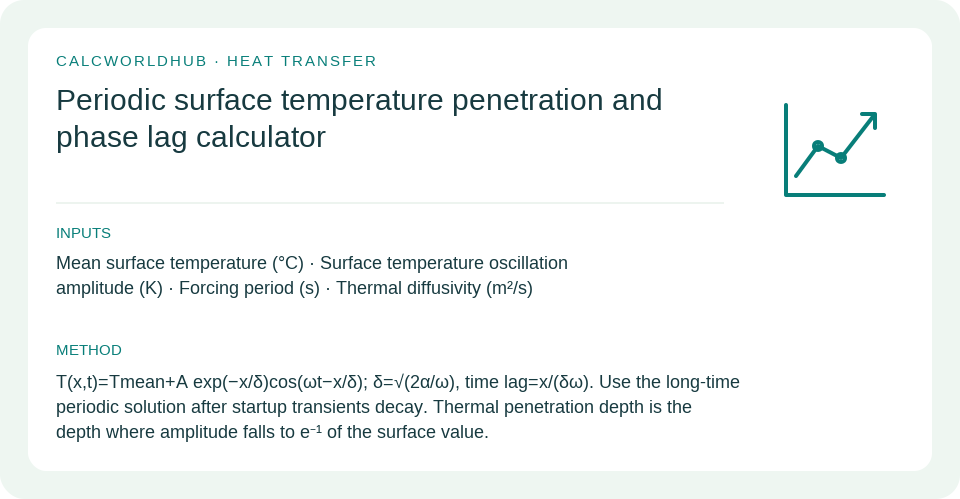
T(x,t)=Tmean+A exp(−x/δ)cos(ωt−x/δ); δ=√(2α/ω), time lag=x/(δω).
Use the long-time periodic solution after startup transients decay. Thermal penetration depth is the depth where amplitude falls to e⁻¹ of the surface value.
A worked scenario
Mean surface temperature (°C) = 15; Surface temperature oscillation amplitude (K) = 10; Forcing period (s) = 86400; Thermal diffusivity (m²/s) = 8.00000000e-07; Depth below surface (m) = 0.15; Time measured from surface maximum (s) = 21600.
- Temperature at depth and time: 18.08287 °C
- Local temperature amplitude: 3.637591 K
- Unwrapped time lag: 13905.871273 s
- Thermal penetration depth: 0.148329 m
A daily 10 K surface oscillation about 15 °C enters a solid of diffusivity 8e−7 m²/s. At 0.15 m depth its amplitude is only 3.63759 K and its phase lag is 13,905.9 s; at the selected six-hour time the temperature is 18.0829 °C.
Assumptions and edge cases
Semi-infinite homogeneous solid with sinusoidal prescribed surface temperature, constant diffusivity and no groundwater advection or phase change.
Reading the outputs
Temperature and amplitude use °C/K; unwrapped lag and period use seconds, penetration depth metres.
Frequently asked questions
Is the lag limited to one cycle?
No. The reported lag is unwrapped; phase can be reduced modulo one period when comparing cyclic peaks.
Does penetration depth mean no temperature change deeper than that?
No. Amplitude decays exponentially rather than ending abruptly.
Can this describe a newly switched-on oscillation?
Not immediately. It represents the established periodic regime.
How do I use the Periodic surface temperature penetration and phase lag calculator?
Enter Mean surface temperature (°C), Surface temperature oscillation amplitude (K), Forcing period (s), Thermal diffusivity (m²/s), then complete the remaining labeled fields. Match the units shown beside each field and review the result together with the assumptions below.
What is a worked example of Periodic surface temperature penetration and phase lag?
Mean surface temperature (°C) = 15; Surface temperature oscillation amplitude (K) = 10; Forcing period (s) = 86400; Thermal diffusivity (m²/s) = 8.00000000e-07; Depth below surface (m) = 0.15; Time measured from surface maximum (s) = 21600. Temperature at depth and time: 18.08287 °C Local temperature amplitude: 3.637591 K Unwrapped time lag: 13905.871273 s Thermal penetration depth: 0.148329 m A daily 10 K surface oscillation about 15 °C enters a solid of diffusivity 8e−7 m²/s. At 0.15 m depth its amplitude is only 3.63759 K and its phase lag is 13,905.9 s; at the selected six-hour time the temperature is 18.0829 °C.
Read our calculation methodology.