Power factor correction capacity calculator
Estimate the capacitor-bank reactive power needed to raise a load’s power factor to a target. Enter your values below to see the result and method.
inputs.
Related calculators
These tools cover nearby questions while keeping this page focused on its own calculation.
How to use this calculator
Estimate the capacitor-bank reactive power needed to raise a load’s power factor to a target.
- Enter Real load power (kW), Initial power factor, Target power factor. Match the units shown beside each field and review the result together with the assumptions below.
- Read the worked example below to check the expected input format and result.
- Compare another scenario by changing one input at a time. Use Reset to return to the starting values.
Define the component and operating point
The required kvar depends on both initial and target power factor. The target must exceed the initial value; capacitor sizing also depends on phase arrangement, harmonics, and switching conditions. Estimate the capacitor-bank reactive power needed to raise a load’s power factor to a target.
Inputs and units
Use the units printed beside each field. These values are Real load power (kW), Initial power factor, Target power factor.
- Real load power (kW): Real load power as defined for the physical or engineering situation.
- Initial power factor: Enter the load’s existing power factor as a fraction between zero and one.
- Target power factor: Enter the desired power factor as a fraction above the initial value and no greater than one.
Design equation and example
Qc = P[tan(acos PF₁) − tan(acos PF₂)]
A 50 kW load corrected from PF 0.75 to 0.95 needs about 27.7 kvar.
Intermediate values are kept unrounded; the displayed result is rounded for readability.
Applying the result in a system
The required kvar depends on both initial and target power factor. The target must exceed the initial value; capacitor sizing also depends on phase arrangement, harmonics, and switching conditions.
Assumptions and limitations
Assumes a sinusoidal load and target leading/lagging direction is not modeled; verify harmonics and utility requirements before selecting equipment.
Frequently asked questions
Which measurements belong in the power factor correction capacity?
Enter Real load power (kW), Initial power factor, Target power factor. Verify that the values use the same operating condition and unit system.
What can make a real installation differ from this power factor correction capacity estimate?
Assumes a sinusoidal load and target leading/lagging direction is not modeled; verify harmonics and utility requirements before selecting equipment.
How do I use the Power factor correction capacity calculator?
Enter Real load power (kW), Initial power factor, Target power factor. Match the units shown beside each field and review the result together with the assumptions below.
What is a worked example of Power factor correction capacity?
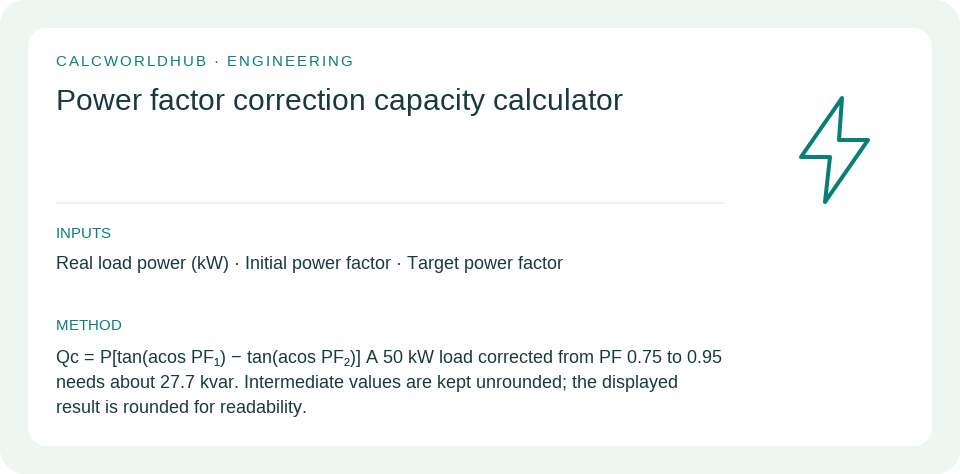
Qc = P[tan(acos PF₁) − tan(acos PF₂)] A 50 kW load corrected from PF 0.75 to 0.95 needs about 27.7 kvar. Intermediate values are kept unrounded; the displayed result is rounded for readability.
What does the Power factor correction capacity calculator calculate?
Estimate the capacitor-bank reactive power needed to raise a load’s power factor to a target.
Read the calculation methodology and privacy policy.