PV equivalent full-load hours calculator
Calculate daily generation divided by array rated power. Enter your values below for a free estimate, with no account required.
inputs.
Calculator
How to use the PV equivalent full-load hours calculator
Calculate daily generation divided by array rated power. Enter your values below for a free estimate, with no account required.
What this calculator measures
Estimate equivalent full-load sun hours from peak-sun hours and system performance, plus a simple battery-runtime estimate from usable capacity and average load.
Inputs and units
The required fields are PV array rated power (kW), Peak sun hours per day, System performance ratio (0–1), Battery capacity (kWh), Average load (kW), Battery usable fraction (0–1). Each value should describe the same object, sample, transaction, or time period wherever the formula compares them.
- PV array rated power (kW): Enter a percentage in the format shown; do not switch between a whole percent and a decimal fraction.
- Peak sun hours per day: Use a whole-number count when the field represents discrete trials, items, people, or periods.
- System performance ratio (0–1): Enter the value that matches the field label and its displayed unit.
- Battery capacity (kWh): Enter the value that matches the field label and its displayed unit.
- Average load (kW): Enter the value that matches the field label and its displayed unit.
- Battery usable fraction (0–1): Enter the value that matches the field label and its displayed unit.
Formula and method
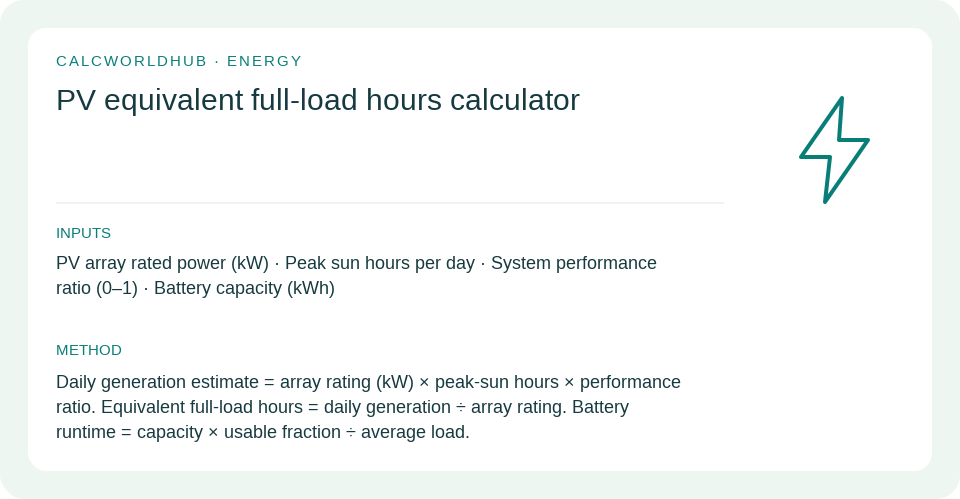
Daily generation estimate = array rating (kW) × peak-sun hours × performance ratio. Equivalent full-load hours = daily generation ÷ array rating. Battery runtime = capacity × usable fraction ÷ average load.
Worked example
With a 5 kW array, 4.5 peak-sun hours and a 0.80 performance ratio, estimated generation is 18 kWh and the equivalent full-load duration is 18 ÷ 5 = 3.6 hours. A 10 kWh battery at 85% usable capacity serving a 0.7 kW load gives 8.5 ÷ 0.7 ≈ 12.14 hours before inverter, temperature, and standby losses.
How to use the calculator
- Read the field labels and select values from the same source and measurement basis.
- Enter PV array rated power (kW) and the other required values. Use the units printed on the page and convert mixed units first.
- Review the displayed method, then compare the result with the question you are trying to answer.
- Change one input at a time to see which assumption has the greatest effect on the result.
Interpreting the result
The first result expresses estimated daily PV energy as hours at the array’s rated output. The separate runtime estimate is a simplified battery-only duration; it does not predict solar charging during discharge or account for changing loads.
Assumptions and limits
Peak-sun hours summarize daily solar energy as equivalent hours at a reference irradiance; they are not the clock hours between sunrise and sunset. The performance ratio is an entered aggregate allowance for system losses. Battery runtime assumes constant load and usable energy, with no additional inverter or battery losses. The array must have positive rated power and the average load must be positive.
Use consistent units, definitions, and measurement conditions for every input. The result follows the chosen formula; check whether real-world constraints or external rules require additional adjustments.
Frequently asked questions
What information do I need?
Enter array rating in kW, peak-sun hours per day, a performance fraction from 0 to 1, battery capacity in kWh, average load in kW, and usable battery fraction from 0 to 1. Use the same day and system boundary for the energy estimate.
How should I interpret the result?
Equivalent full-load hours are daily estimated PV energy divided by array rating. Battery runtime is usable battery energy divided by average load; both are planning estimates with constant-input assumptions.
Is the PV equivalent full-load hours calculator free to use?
Yes. This calculator is free and works in your browser without an account.
How do I use the PV equivalent full-load hours calculator?
Enter PV array rated power (kW), Peak sun hours per day, System performance ratio (0–1), Battery capacity (kWh), then complete the remaining labeled fields. Match the units shown beside each field and review the result together with the assumptions below.
What is a worked example of PV equivalent full-load hours?
With a 5 kW array, 4.5 peak-sun hours and a 0.80 performance ratio, estimated generation is 18 kWh and the equivalent full-load duration is 18 ÷ 5 = 3.6 hours. A 10 kWh battery at 85% usable capacity serving a 0.7 kW load gives 8.5 ÷ 0.7 ≈ 12.14 hours before inverter, temperature, and standby losses.
Read the calculation methodology and privacy policy.
Good calculators show their work.
CalcWorldHub is built around clear inputs and visible assumptions. Results are estimates for planning; check official sources or your provider’s terms when exact figures matter.