Pythagorean theorem calculator
Solve for the missing leg of a right triangle from its hypotenuse and other leg.
inputs.
How to use this calculator
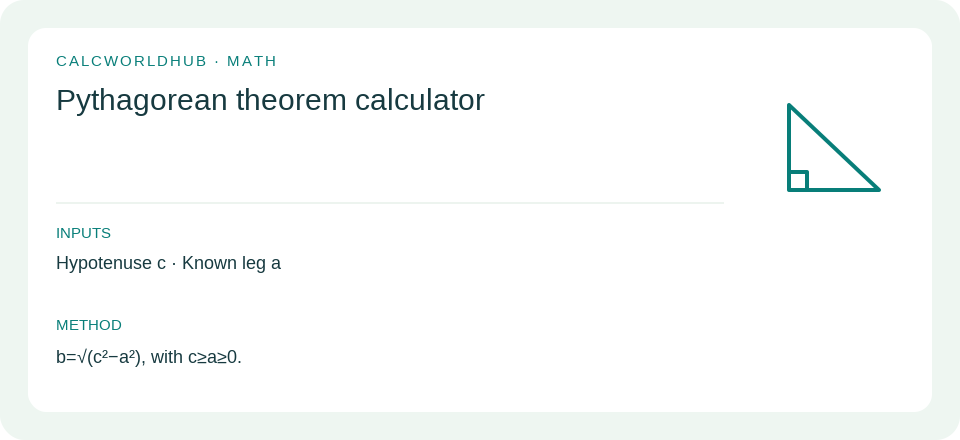
For a right triangle, the square of the hypotenuse equals the sum of the squares of its two legs. When the hypotenuse and one leg are known, subtract the known leg’s square from the hypotenuse’s square, then take the square root. The hypotenuse must be longer than the known leg, and both measurements must use the same unit.
Formula
Missing leg b = √(c² − a²), where c > a
Assumptions and limits
Inputs should use consistent units and valid values. The result is a planning aid; review the assumptions above and verify the method fits your situation before relying on it.
How to use this calculator
Solve for the missing leg of a right triangle from its hypotenuse and other leg.
- Enter Hypotenuse c, Known leg a. Match the units shown beside each field and review the result together with the assumptions below.
- Read the worked example below to check the expected input format and result.
- Compare another scenario by changing one input at a time. Use Reset to return to the starting values.
How the Pythagorean theorem calculator works
Solve for the missing leg of a right triangle from its hypotenuse and other leg.
Inputs and units
- Hypotenuse c: Hypotenuse c is the side opposite the right angle and must be nonnegative.
- Known leg a: Known leg a must be nonnegative and no longer than c.
Formula and method
b=√(c²−a²), with c≥a≥0.
Worked example
A hypotenuse of 13 and a known leg of 5 gives √(169−25)=12. A known leg of zero gives the degenerate limit 13.
Interpreting the result
The result is a nonnegative length. Equality c=a yields a zero missing leg and is a degenerate triangle.
Assumptions and limits
Inputs must be lengths in the same units, with hypotenuse c at least as large as the known leg. Negative lengths are not meaningful.
Frequently asked questions
What happens if the known leg equals the hypotenuse?
The missing leg is zero, a degenerate boundary rather than a nonzero-area triangle.
Can c be smaller than the known leg?
No. A hypotenuse must be at least as long as either leg.
How do I use the Pythagorean theorem calculator?
Enter Hypotenuse c, Known leg a. Match the units shown beside each field and review the result together with the assumptions below.
What is a worked example of Pythagorean theorem?
A hypotenuse of 13 and a known leg of 5 gives √(169−25)=12. A known leg of zero gives the degenerate limit 13.
What does the Pythagorean theorem calculator calculate?
Solve for the missing leg of a right triangle from its hypotenuse and other leg.
Browse more Math calculators · See the calculation methodology.