How to use this calculator
Estimate the local difference in radial gravitational acceleration across a short separation.
- Enter Gravitational parameter (km³/s²), Distance to central mass (km), Small radial separation (m). Match the units shown beside each field and review the result together with the assumptions below.
- Read the worked example below to check the expected input format and result.
- Compare another scenario by changing one input at a time. Use Reset to return to the starting values.
Radial gravitational tidal acceleration explained
Use Gravitational parameter (km³/s²) with Distance to central mass (km) to reproduce the sample calculation, then review the stated limits before carrying the result into another scenario.
A numerical walkthrough
Gravitational parameter (km³/s²) = 398600.4418; Distance to central mass (km) = 7000; Small radial separation (m) = 2.
- Approximate radial differential acceleration: 0.0000046484 m/s²
The result is the first-order radial acceleration difference across the entered 2 m separation at a 7,000 km radius. It is small relative to the central distance, which supports the linear-gradient approximation; it is not the ordinary gravitational acceleration or a tangential component.
The model behind the numbers
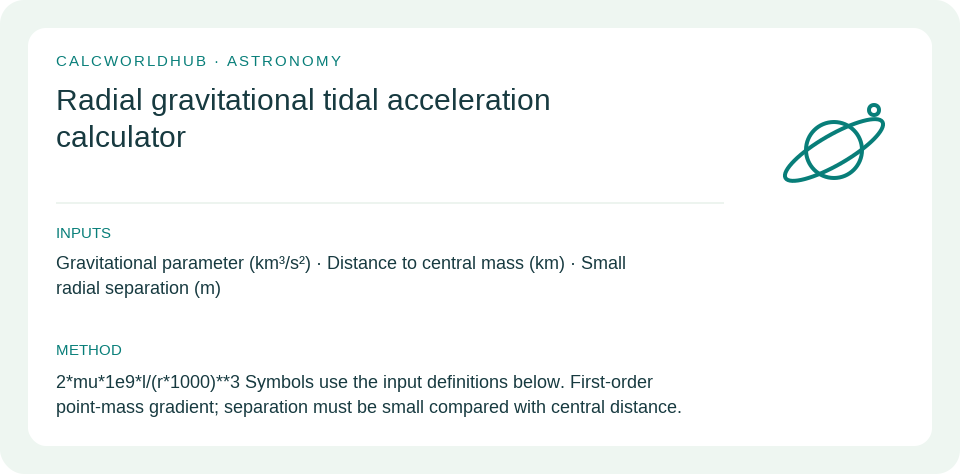
2*mu*1e9*l/(r*1000)**3
Symbols use the input definitions below. First-order point-mass gradient; separation must be small compared with central distance.
What to enter
mu— Gravitational parameter (km³/s²)- Gravitational parameter (km³/s²).
r— Distance to central mass (km)- Distance to central mass (km).
l— Small radial separation (m)- Small radial separation (m).
Interpreting the result
First-order point-mass gradient; separation must be small compared with central distance. Rotation and material response are excluded.
Sources
Frequently asked questions
Is this ordinary gravity?
It is the difference in gravity across the entered separation.
Can I use a large separation?
The linear gradient approximation then fails.
Is radial stretching the same as tangential response?
No, tangential tidal components differ.
How do I use the Radial gravitational tidal acceleration calculator?
Enter Gravitational parameter (km³/s²), Distance to central mass (km), Small radial separation (m). Match the units shown beside each field and review the result together with the assumptions below.
What is a worked example of Radial gravitational tidal acceleration?
Gravitational parameter (km³/s²) = 398600.4418; Distance to central mass (km) = 7000; Small radial separation (m) = 2. Approximate radial differential acceleration: 0.0000046484 m/s² The result is the first-order radial acceleration difference across the entered 2 m separation at a 7,000 km radius. It is small relative to the central distance, which supports the linear-gradient approximation; it is not the ordinary gravitational acceleration or a tangential component.
Read our calculation methodology.