How to use this calculator
Locate both Raman sidebands of one vibrational mode and predict their equilibrium anti-Stokes/Stokes ratio under a stated detector convention.
- Enter Vacuum wavelength (nm), Vibrational Raman shift (cm⁻¹), Thermal population temperature (K), Frequency response exponent: 3 or 4. Match the units shown beside each field and review the result together with the assumptions below.
- Read the worked example below to check the expected input format and result.
- Compare another scenario by changing one input at a time. Use Reset to return to the starting values.
Raman sideband wavelengths and thermal intensity ratio explained
A numerical walkthrough
Vacuum wavelength (nm) = 532; Vibrational Raman shift (cm⁻¹) = 520; Thermal population temperature (K) = 300; Frequency response exponent: 3 or 4 = 4.
- Stokes emission wavelength: 547.135969 nm
- Anti Stokes emission wavelength: 517.67893 nm
- Thermal anti Stokes to Stokes ratio: 0.103053
- Log anti Stokes to Stokes ratio: -2.272511 natural log
A 520 cm⁻¹ mode excited at 532 nm produces a Stokes line near 547.14 nm and an anti-Stokes line near 517.68 nm.
The model behind the numbers
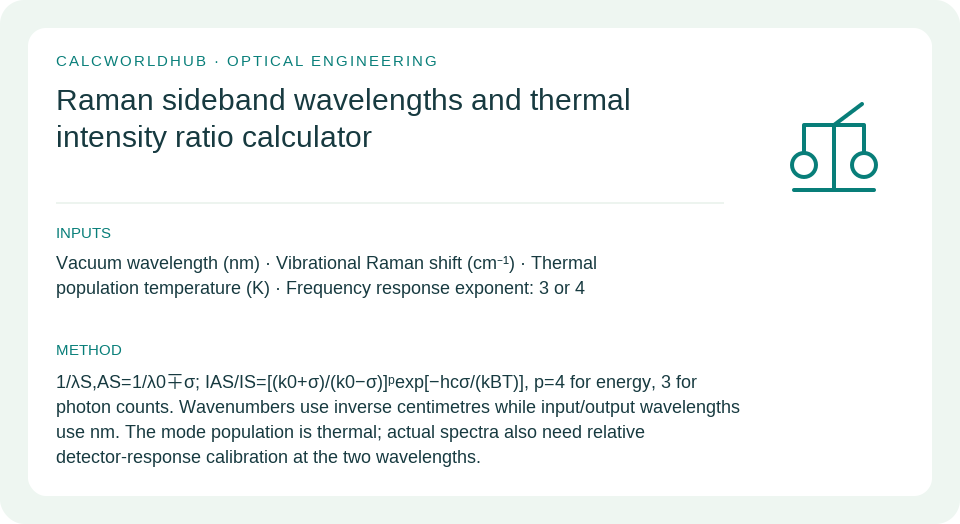
1/λS,AS=1/λ0∓σ; IAS/IS=[(k0+σ)/(k0−σ)]ᵖexp[−hcσ/(kBT)], p=4 for energy, 3 for photon counts.
Wavenumbers use inverse centimetres while input/output wavelengths use nm. The mode population is thermal; actual spectra also need relative detector-response calibration at the two wavelengths.
What to enter
wavelength— Vacuum wavelength (nm)- Monochromatic vacuum wavelength in nanometres.
shift— Vibrational Raman shift (cm⁻¹)- Positive vibrational wavenumber measured from the laser.
temperature— Thermal population temperature (K)- Absolute equilibrium temperature of the vibrational mode.
exponent— Frequency response exponent: 3 or 4- Use four for radiant-energy intensity; use three for ideal photon-counting line counts. Enter a whole number.
Interpreting the result
One equilibrium vibrational mode with equal scattering matrix elements for the two sidebands. Resonance Raman enhancement, laser heating and unequal throughput invalidate an uncalibrated temperature inference.
Reading the outputs
The first two outputs are nm. The thermal ratio is dimensionless and its natural logarithm remains useful when the ratio is extremely small.
Frequently asked questions
Why are anti-Stokes lines weaker at low temperature?
Few molecules initially occupy the excited vibrational level required to return energy to the scattered photon.
Why does photon counting use a different exponent?
Each detected photon carries frequency-dependent energy; converting radiant energy to photon counts removes one frequency factor.
Can I infer the sample temperature from a raw ratio?
Only after correcting the relative spectral response and checking equilibrium and resonance assumptions.
How do I use the Raman sideband wavelengths and thermal intensity ratio calculator?
Enter Vacuum wavelength (nm), Vibrational Raman shift (cm⁻¹), Thermal population temperature (K), Frequency response exponent: 3 or 4. Match the units shown beside each field and review the result together with the assumptions below.
What is a worked example of Raman sideband wavelengths and thermal intensity ratio?
Vacuum wavelength (nm) = 532; Vibrational Raman shift (cm⁻¹) = 520; Thermal population temperature (K) = 300; Frequency response exponent: 3 or 4 = 4. Stokes emission wavelength: 547.135969 nm Anti Stokes emission wavelength: 517.67893 nm Thermal anti Stokes to Stokes ratio: 0.103053 Log anti Stokes to Stokes ratio: -2.272511 natural log A 520 cm⁻¹ mode excited at 532 nm produces a Stokes line near 547.14 nm and an anti-Stokes line near 517.68 nm.
Background or definition reference: Original Raman thermometry study: detector-response convention.
Read our calculation methodology.