How to use this calculator
Balance a basic steam power cycle using state enthalpies obtained from a reliable steam-property source.
- Enter Condenser outlet enthalpy (kJ/kg), Pump outlet enthalpy (kJ/kg), Boiler outlet enthalpy (kJ/kg), Turbine outlet enthalpy (kJ/kg). Match the units shown beside each field and review the result together with the assumptions below.
- Read the worked example below to check the expected input format and result.
- Compare another scenario by changing one input at a time. Use Reset to return to the starting values.
Rankine cycle from supplied state enthalpies explained
Calculate idealized Rankine-cycle turbine work, pump work, heat input, and efficiency from four supplied state enthalpies.
A numerical walkthrough
Condenser outlet enthalpy (kJ/kg) = 190; Pump outlet enthalpy (kJ/kg) = 200; Boiler outlet enthalpy (kJ/kg) = 3400; Turbine outlet enthalpy (kJ/kg) = 2300.
- Cycle efficiency: 34.0625 %
- Net specific work: 1090 kJ/kg
- Boiler heat: 3200 kJ/kg
- Back work ratio: 0.909091 %
State enthalpies 190, 200, 3,400 and 2,300 kJ/kg give 1,100 kJ/kg turbine work and 10 kJ/kg pump work. The 1,090 kJ/kg net output is 34.0625% of the 3,200 kJ/kg boiler input.
The model behind the numbers
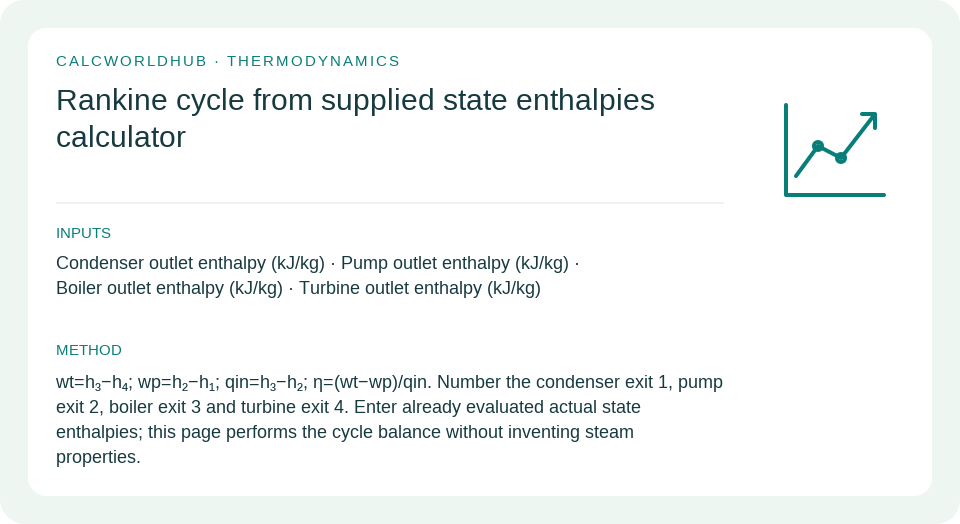
wt=h₃−h₄; wp=h₂−h₁; qin=h₃−h₂; η=(wt−wp)/qin.
Number the condenser exit 1, pump exit 2, boiler exit 3 and turbine exit 4. Enter already evaluated actual state enthalpies; this page performs the cycle balance without inventing steam properties.
What to enter
h1— Condenser outlet enthalpy (kJ/kg)- Condenser outlet enthalpy (kJ/kg). Enter the value for this state; the units shown are used without an unstated conversion.
h2— Pump outlet enthalpy (kJ/kg)- Pump outlet enthalpy (kJ/kg). Enter the value for this state; the units shown are used without an unstated conversion.
h3— Boiler outlet enthalpy (kJ/kg)- Boiler outlet enthalpy (kJ/kg). Enter the value for this state; the units shown are used without an unstated conversion.
h4— Turbine outlet enthalpy (kJ/kg)- Turbine outlet enthalpy (kJ/kg). Enter the value for this state; the units shown are used without an unstated conversion.
Interpreting the result
No built-in steam tables or property validation. Supplied enthalpies must belong to one physically consistent cycle. Kinetic, potential and pipe heat losses are neglected.
Reading the outputs
Cycle efficiency, net work and boiler heat are per kilogram through the boiler; back work ratio compares pump consumption with turbine production.
Frequently asked questions
Where do I enter turbine efficiency?
Use it upstream to calculate actual h4; this balance takes actual state enthalpies.
Can a saturated boiler outlet be used?
Yes, if the supplied state set is consistent; this page does not select a steam region.
Does the result include generator losses?
No. Net specific work is mechanical cycle work before generator losses.
How do I use the Rankine cycle from supplied state enthalpies calculator?
Enter Condenser outlet enthalpy (kJ/kg), Pump outlet enthalpy (kJ/kg), Boiler outlet enthalpy (kJ/kg), Turbine outlet enthalpy (kJ/kg). Match the units shown beside each field and review the result together with the assumptions below.
What is a worked example of Rankine cycle from supplied state enthalpies?
Condenser outlet enthalpy (kJ/kg) = 190; Pump outlet enthalpy (kJ/kg) = 200; Boiler outlet enthalpy (kJ/kg) = 3400; Turbine outlet enthalpy (kJ/kg) = 2300. Cycle efficiency: 34.0625 % Net specific work: 1090 kJ/kg Boiler heat: 3200 kJ/kg Back work ratio: 0.909091 % State enthalpies 190, 200, 3,400 and 2,300 kJ/kg give 1,100 kJ/kg turbine work and 10 kJ/kg pump work. The 1,090 kJ/kg net output is 34.0625% of the 3,200 kJ/kg boiler input.
Background or definition reference: DOE Fundamentals Handbook: thermodynamic energy balances.
Read our calculation methodology.