How to use this calculator
Estimate ideal constant-area frictionless heat addition available before a Rayleigh flow reaches its sonic limit.
- Enter Current Mach number, Heat-capacity ratio, Current stagnation temperature (K), Constant cp (kJ/kg/K). Match the units shown beside each field and review the result together with the assumptions below.
- Read the worked example below to check the expected input format and result.
- Compare another scenario by changing one input at a time. Use Reset to return to the starting values.
Rayleigh flow heat addition to sonic limit explained
How the calculation works
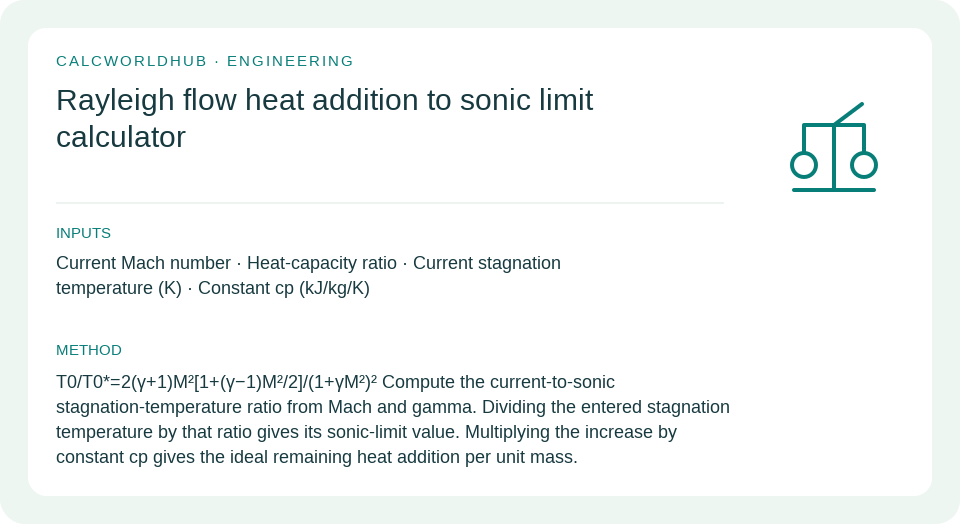
T0/T0*=2(γ+1)M²[1+(γ−1)M²/2]/(1+γM²)²
Compute the current-to-sonic stagnation-temperature ratio from Mach and gamma. Dividing the entered stagnation temperature by that ratio gives its sonic-limit value. Multiplying the increase by constant cp gives the ideal remaining heat addition per unit mass.
Set up the calculation
m— Current Mach number- Current Mach number.
g— Heat-capacity ratio- Heat-capacity ratio.
t— Current stagnation temperature (K)- Current stagnation temperature (K).
cp— Constant cp (kJ/kg/K)- Constant cp (kJ/kg/K).
Limits of this model
Calorically perfect gas, no friction or shaft work, and a constant-area duct; actual combustion and variable properties are excluded.
Check this example
Current Mach number = 0.3; Heat-capacity ratio = 1.4; Current stagnation temperature (K) = 300; Constant cp (kJ/kg/K) = 1.005.
- Ideal heat addition to sonic limit: 567.72572855 kJ/kg
- Sonic-limit stagnation temperature: 864.90122244 K
Interpreting the result
The reported heat is the ideal stagnation-enthalpy rise needed to reach the sonic Rayleigh state at the supplied starting Mach number. It is a one-dimensional constant-area ideal-flow limit, not a burner or combustor design rating.
Frequently asked questions
Can both subsonic and supersonic states approach sonic conditions?
Yes, under ideal Rayleigh heat addition.
Is static temperature maximum exactly at Mach one?
Not generally; the displayed limit concerns stagnation temperature.
Is this a burner sizing result?
No, it is an ideal flow-model bound.
How do I use the Rayleigh flow heat addition to sonic limit calculator?
Enter Current Mach number, Heat-capacity ratio, Current stagnation temperature (K), Constant cp (kJ/kg/K). Match the units shown beside each field and review the result together with the assumptions below.
What is a worked example of Rayleigh flow heat addition to sonic limit?
Current Mach number = 0.3; Heat-capacity ratio = 1.4; Current stagnation temperature (K) = 300; Constant cp (kJ/kg/K) = 1.005. Ideal heat addition to sonic limit: 567.72572855 kJ/kg Sonic-limit stagnation temperature: 864.90122244 K
Method reference: NACA report 1135 compressible-flow relations.
Read our calculation methodology.