How to use this calculator
Inspect repeating spectral structure through a real cepstral coefficient rather than a frequency-bin magnitude.
- Enter Uniform samples (signal units), Quefrency index. Match the units shown beside each field and review the result together with the assumptions below.
- Read the worked example below to check the expected input format and result.
- Compare another scenario by changing one input at a time. Use Reset to return to the starting values.
Real cepstrum at a quefrency explained
A numerical walkthrough
Uniform samples (signal units) = [1, 0.5, 0.2, 0.1, 0, 0, 0, 0]; Quefrency index = 1.
- Real cepstral coefficient: 0.250668 log-amplitude units
- Zero-quefrency coefficient: -0.00089 log-amplitude units
The default short decaying pulse has a nonflat spectrum; its first cepstral coefficient quantifies spectral structure at one sample of quefrency.
The model behind the numbers
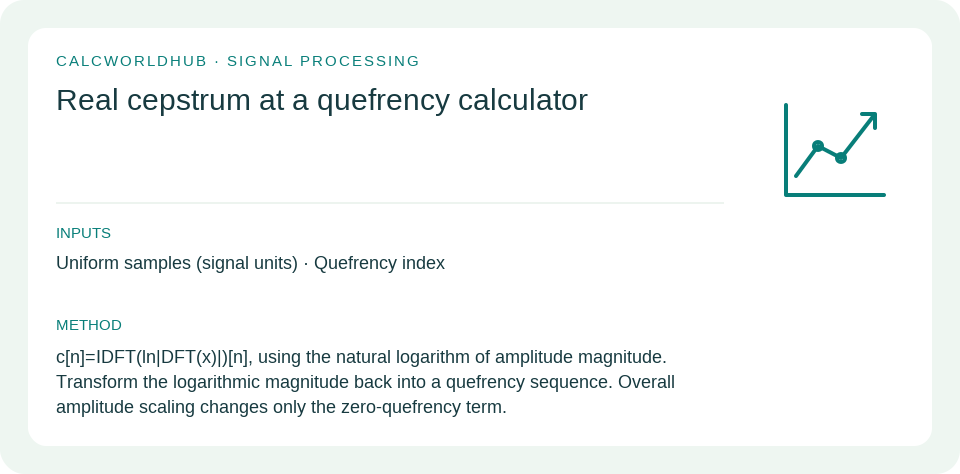
c[n]=IDFT(ln|DFT(x)|)[n], using the natural logarithm of amplitude magnitude.
Transform the logarithmic magnitude back into a quefrency sequence. Overall amplitude scaling changes only the zero-quefrency term.
What to enter
x— Uniform samples (signal units)- Chronological real samples; use a comma-separated list in the same signal units. Use comma-separated values in the stated order.
q— Quefrency index- Zero-based real-cepstrum sample index. Enter a whole number.
Interpreting the result
Exact or near-zero spectral bins are rejected instead of adding an undocumented log floor. This is the real, not complex, cepstrum.
Reading the outputs
Coefficients use natural-log amplitude units; multiply quefrency index by the sample interval to express a delay.
Frequently asked questions
Why is phase discarded?
The real cepstrum starts from magnitude only.
Is quefrency measured in hertz?
No; with a sample rate it corresponds to time.
What happens if I multiply all samples by two?
Only c[0] increases by ln(2), apart from roundoff.
How do I use the Real cepstrum at a quefrency calculator?
Enter Uniform samples (signal units), Quefrency index. Match the units shown beside each field and review the result together with the assumptions below.
What is a worked example of Real cepstrum at a quefrency?
Uniform samples (signal units) = [1, 0.5, 0.2, 0.1, 0, 0, 0, 0]; Quefrency index = 1. Real cepstral coefficient: 0.250668 log-amplitude units Zero-quefrency coefficient: -0.00089 log-amplitude units The default short decaying pulse has a nonflat spectrum; its first cepstral coefficient quantifies spectral structure at one sample of quefrency.
Read our calculation methodology.