How to use this calculator
Calculate asphalt-mixture theoretical maximum specific gravity and density from Rice-test measurements.
- Enter Oven-dry loose-mixture mass in air, A (g), Calibrated container with water and cover plate, D (g), Container, sample, water, and cover plate, E (g). Match the units shown beside each field and review the result together with the assumptions below.
- Read the worked example below to check the expected input format and result.
- Compare another scenario by changing one input at a time. Use Reset to return to the starting values.
How this calculation works
Enter the oven-dry loose-mixture mass in air, the calibrated container mass with water and cover plate, and the container with mixture, water, and cover plate together. Use one mass unit throughout and follow the method's specified water temperature and vacuum procedure.
Inputs and units
sampleMass— Oven-dry loose-mixture mass in air, A (g)- Dry asphalt mixture sample mass before the test.
containerWaterMass— Calibrated container with water and cover plate, D (g)- Reference mass of the calibrated container filled as specified.
containerSampleWaterMass— Container, sample, water, and cover plate, E (g)- Measured combined mass after the test setup is completed.
Formula
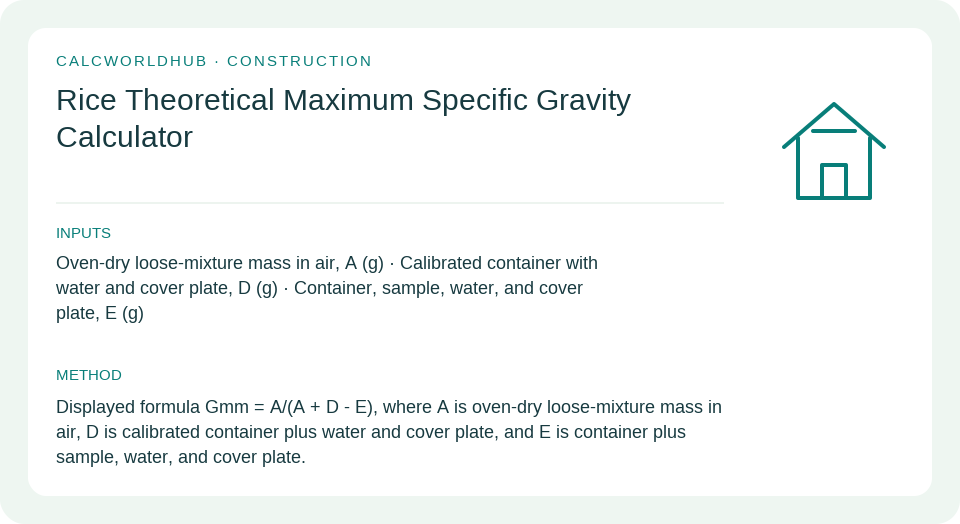
Gmm = A/(A + D - E), where A is oven-dry loose-mixture mass in air, D is calibrated container plus water and cover plate, and E is container plus sample, water, and cover plate.
Method
Add sample mass A to calibrated water-filled-container mass D, subtract combined mass E, then divide A by the result. This yields dimensionless theoretical maximum specific gravity.
Worked example
For A = 5,000 g, D = 6,000 g, and E = 9,000 g, Gmm = 5,000/(5,000 + 6,000 - 9,000) = 2.500.
Assumptions and limits
This reduces recorded measurements only. It does not perform vacuum saturation, temperature correction, equipment calibration, or acceptance testing. Use readings from the same calibrated container and governing test method.
Frequently asked questions
What does Gmm represent?
Gmm is the theoretical maximum specific gravity of loose asphalt mixture with no air voids.
Are the three masses interchangeable?
No. Each reading has a distinct test setup and role; follow the cited method for the calibrated container and water.
Does this calculator run the Rice test?
No. It only reduces entered measurements; it does not perform sample preparation, vacuum saturation, calibration, or temperature control.
How do I use the Rice Theoretical Maximum Specific Gravity Calculator?
Enter Oven-dry loose-mixture mass in air, A (g), Calibrated container with water and cover plate, D (g), Container, sample, water, and cover plate, E (g). Match the units shown beside each field and review the result together with the assumptions below.
What is a worked example of Rice Theoretical Maximum Specific Gravity?
For A = 5,000 g, D = 6,000 g, and E = 9,000 g, Gmm = 5,000/(5,000 + 6,000 - 9,000) = 2.500.
Reference: Caltrans California Test 309 Rice procedure for HMA theoretical maximum specific gravity. See our calculation methodology.