How to use this calculator
Estimate long-term average sheet and rill soil loss from compatible R, K, LS, C, and P factors.
- Enter Rainfall erosivity R factor, Soil erodibility K factor, Combined slope-length and steepness LS factor, Cover-management C factor, then complete the remaining labeled fields. Match the units shown beside each field and review the result together with the assumptions below.
- Read the worked example below to check the expected input format and result.
- Compare another scenario by changing one input at a time. Use Reset to return to the starting values.
How this calculation works
The Revised Universal Soil Loss Equation combines climate erosivity, soil erodibility, slope, cover, and support-practice factors. Enter values supplied for the site and method version; this calculator multiplies them to estimate average annual soil loss.
Inputs and units
rFactor— Rainfall erosivity R factor- Annual erosivity factor from a compatible RUSLE source; keep units paired with K.
kFactor— Soil erodibility K factor- Erodibility factor for the same unit convention as R.
lsFactor— Combined slope-length and steepness LS factor- Topographic factor for the field slope.
coverFactor— Cover-management C factor- Dimensionless crop, cover, and management factor.
practiceFactor— Support-practice P factor- Dimensionless conservation-practice factor.
Formula
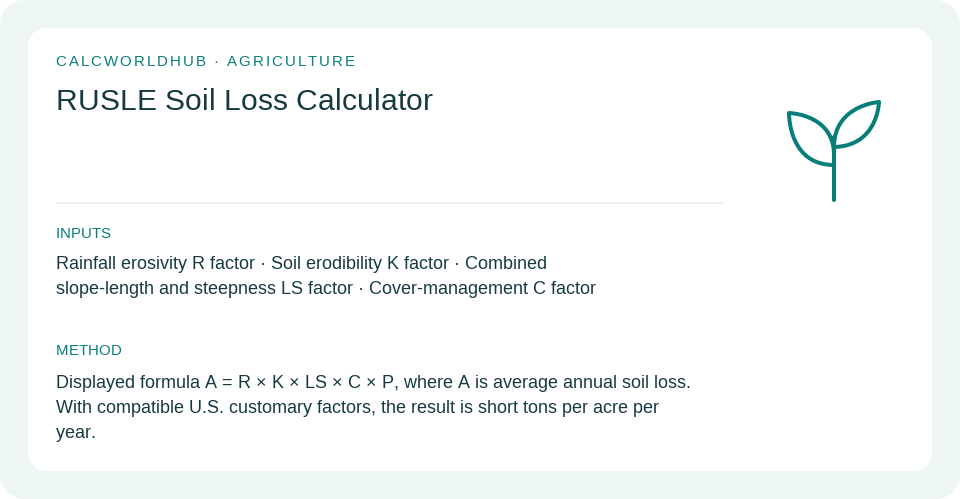
A = R × K × LS × C × P, where A is average annual soil loss. With compatible U.S. customary factors, the result is short tons per acre per year.
Method
Use R and K factors from the same unit system and RUSLE convention, plus combined topographic LS and dimensionless C and P factors. This page evaluates the product; it does not derive factors from maps or management records.
Worked example
Using R = 150, K = 0.28, LS = 1.2, C = 0.15 and P = 0.50 gives A = 3.78 short tons per acre per year.
Assumptions and limits
RUSLE estimates long-term average rill and interrill erosion from rainfall and runoff. It is not a storm runoff or sediment-delivery model. Factor selection is site- and version-dependent; consult USDA/NRCS guidance for conservation decisions.
Frequently asked questions
Does this calculator derive R, K, LS, C, and P?
No. It multiplies factor values you supply. Factor values depend on location, soil, slope, cover, practices, and model version.
Is this an estimate for one storm?
No. This form estimates long-term average annual sheet and rill soil loss.
Can I mix metric R and K with U.S. factors?
No. R and K have units; use a compatible factor set and interpret the result's units accordingly.
Does the result equal sediment delivered to a stream?
No. It estimates soil loss on the slope; deposition and sediment delivery require additional modeling.
How do I use the RUSLE Soil Loss Calculator?
Enter Rainfall erosivity R factor, Soil erodibility K factor, Combined slope-length and steepness LS factor, Cover-management C factor, then complete the remaining labeled fields. Match the units shown beside each field and review the result together with the assumptions below.
Reference: USDA Agricultural Research Service RUSLE equation and factor descriptions. See our calculation methodology.