How to use this calculator
Estimate natural-grain settling speed across viscous, transitional, and turbulent regimes with the Ferguson–Church equation.
- Enter Grain diameter D (mm), Grain density ρs (kg/m³), Fluid density ρf (kg/m³), Kinematic viscosity ν (m²/s), then complete the remaining labeled fields. Match the units shown beside each field and review the result together with the assumptions below.
- Read the worked example below to check the expected input format and result.
- Compare another scenario by changing one input at a time. Use Reset to return to the starting values.
How this calculation works
The Ferguson–Church equation provides an explicit fall-speed estimate across the full range from viscous to turbulent settling. It uses particle diameter, submerged specific gravity, fluid kinematic viscosity, gravity, and two drag-related coefficients. The coefficients can be adjusted for grain shape and for the chosen sieve or nominal diameter convention.
Inputs and units
diameter— Grain diameter D (mm)- Representative natural-grain diameter in millimeters.
rhoSolid— Grain density ρs (kg/m³)- Density of the sediment grains.
rhoFluid— Fluid density ρf (kg/m³)- Density of the surrounding fluid.
nu— Kinematic viscosity ν (m²/s)- Kinematic viscosity of the fluid at the operating temperature.
g— Gravitational acceleration g (m/s²)- Local gravitational acceleration.
c1— Low-Re coefficient C1- Viscous-regime coefficient; 18 is the Stokes value for spheres.
c2— High-Re coefficient C2- High-Re drag coefficient; 1 is a common natural-grain value.
Formula
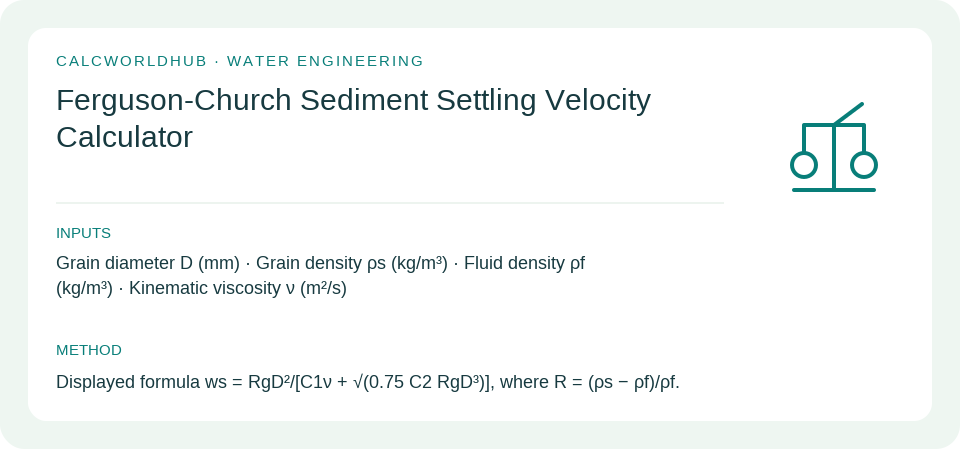
ws = RgD²/[C1ν + √(0.75 C2 RgD³)], where R = (ρs − ρf)/ρf.
Method
Convert grain diameter from millimeters to meters, compute submerged specific gravity R, evaluate the denominator with the selected coefficients C1 and C2, and calculate the positive settling speed. The Reynolds number is reported as wsD/ν.
Worked example
For D = 0.20 mm, ρs = 2,650 kg/m³, ρf = 1,000 kg/m³, ν = 1.00 × 10⁻⁶ m²/s, g = 9.80665 m/s², C1 = 18, and C2 = 1, ws = 0.02324 m/s and Re = 4.647.
Assumptions and limits
This is an isolated-particle estimate in a quiescent fluid. It does not include hindered settling, wall effects, turbulence, flocculation, or concentration-dependent drag. C1 = 18 and C2 = 1 are suggested for typical natural sand grains; choose coefficients consistent with particle shape and diameter definition.
Frequently asked questions
How is this different from Stokes settling?
Stokes' law is restricted to low-Reynolds-number spherical-particle flow. Ferguson–Church gives a continuous explicit estimate through the transitional and turbulent ranges as well.
What coefficient values should I use?
The paper suggests C1 = 18 and C2 = 1 for typical natural grains, with other values for smooth spheres or more angular particles.
Does it include concentrated or flocculated particles?
No. The equation is for an isolated grain. Hindered settling and flocculation require a different model.
How do I use the Ferguson-Church Sediment Settling Velocity Calculator?
Enter Grain diameter D (mm), Grain density ρs (kg/m³), Fluid density ρf (kg/m³), Kinematic viscosity ν (m²/s), then complete the remaining labeled fields. Match the units shown beside each field and review the result together with the assumptions below.
What is a worked example of Ferguson-Church Sediment Settling Velocity?
For D = 0.20 mm, ρs = 2,650 kg/m³, ρf = 1,000 kg/m³, ν = 1.00 × 10⁻⁶ m²/s, g = 9.80665 m/s², C1 = 18, and C2 = 1, ws = 0.02324 m/s and Re = 4.647.
Reference: Ferguson and Church peer-reviewed grain-settling velocity equation. See our calculation methodology.