How to use this calculator
Predict the rising surface temperature and depth response after a constant heat-flux step enters a thick solid.
- Enter Applied surface heat flux (W/m²), Thermal conductivity (W/m/K), Thermal diffusivity (m²/s), Time since heat-flux step (s), then complete the remaining labeled fields. Match the units shown beside each field and review the result together with the assumptions below.
- Read the worked example below to check the expected input format and result.
- Compare another scenario by changing one input at a time. Use Reset to return to the starting values.
Semi infinite solid constant surface heat flux explained
The ideal surface response grows with the square root of elapsed time, while the temperature change at depth also decays with distance from the heated surface.
Inputs, symbols, and units
q— Applied surface heat flux (W/m²)- Applied surface heat flux (W/m²). Enter the value for this state; the units shown are used without an unstated conversion.
k— Thermal conductivity (W/m/K)- Thermal conductivity (W/m/K). Enter the value for this state; the units shown are used without an unstated conversion.
alpha— Thermal diffusivity (m²/s)- Thermal diffusivity (m²/s). Enter the value for this state; the units shown are used without an unstated conversion.
t— Time since heat-flux step (s)- Time since heat-flux step (s). Enter the value for this state; the units shown are used without an unstated conversion.
x— Depth below heated surface (m)- Depth below heated surface (m). Enter the value for this state; the units shown are used without an unstated conversion.
Ti— Uniform initial temperature (°C)- Uniform initial temperature (°C). Enter the value for this state; the units shown are used without an unstated conversion.
Formula and method
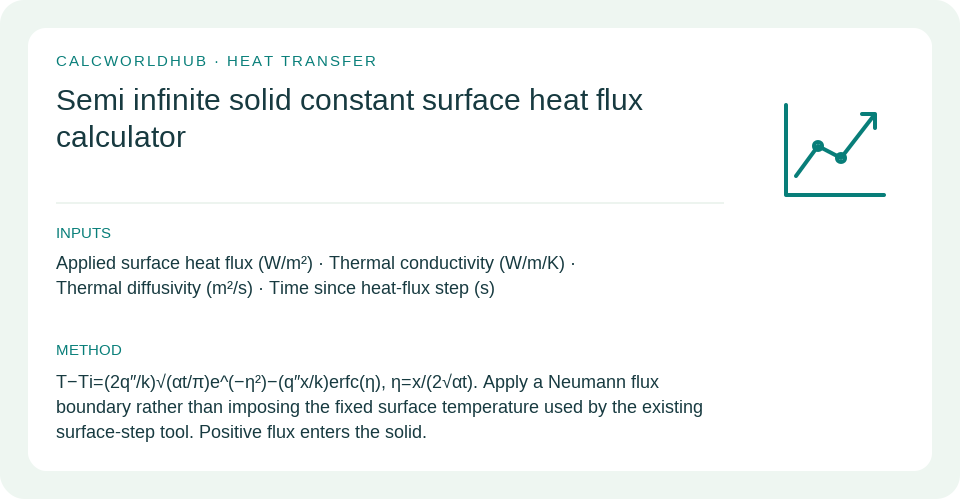
T−Ti=(2q″/k)√(αt/π)e^(−η²)−(q″x/k)erfc(η), η=x/(2√αt).
Apply a Neumann flux boundary rather than imposing the fixed surface temperature used by the existing surface-step tool. Positive flux enters the solid.
A worked scenario
Applied surface heat flux (W/m²) = 10000; Thermal conductivity (W/m/K) = 15; Thermal diffusivity (m²/s) = 0.000004; Time since heat-flux step (s) = 10; Depth below heated surface (m) = 0.005; Uniform initial temperature (°C) = 20.
- Temperature at depth: 22.148946 °C
- Surface temperature: 24.757664 °C
- Energy added per area: 100000 J/m²
A 10,000 W/m² heat-flux step enters a solid with k=15 W/m/K and diffusivity 4e−6 m²/s for 10 s. Surface temperature rises from 20 to 24.7577 °C; at 5 mm depth it reaches only 22.1489 °C while deposited energy is 100,000 J/m².
Assumptions and edge cases
Semi-infinite solid, uniform initial temperature, constant properties and no convection or phase change. For cooling, ensure absolute temperature remains physical.
Reading the outputs
Returns local and surface temperatures plus signed deposited energy per unit area.
Frequently asked questions
Does the surface stay at one temperature?
No. It changes with square root of time because the applied flux stays fixed.
Can flux be negative?
Yes for idealized extraction; reject physically impossible temperatures in application.
When is a thick slab effectively semi-infinite?
When the thermal penetration depth remains small compared with distance to the remote boundary.
How do I use the Semi infinite solid constant surface heat flux calculator?
Enter Applied surface heat flux (W/m²), Thermal conductivity (W/m/K), Thermal diffusivity (m²/s), Time since heat-flux step (s), then complete the remaining labeled fields. Match the units shown beside each field and review the result together with the assumptions below.
What is a worked example of Semi infinite solid constant surface heat flux?
Applied surface heat flux (W/m²) = 10000; Thermal conductivity (W/m/K) = 15; Thermal diffusivity (m²/s) = 0.000004; Time since heat-flux step (s) = 10; Depth below heated surface (m) = 0.005; Uniform initial temperature (°C) = 20. Temperature at depth: 22.148946 °C Surface temperature: 24.757664 °C Energy added per area: 100000 J/m² A 10,000 W/m² heat-flux step enters a solid with k=15 W/m/K and diffusivity 4e−6 m²/s for 10 s. Surface temperature rises from 20 to 24.7577 °C; at 5 mm depth it reaches only 22.1489 °C while deposited energy is 100,000 J/m².
Read our calculation methodology.