How to use this calculator
Calculate RMSSD, SDNN, and mean heart rate from a clean sequence of normal-to-normal intervals.
- Enter Normal-to-normal intervals, RR (ms), in order. Match the units shown beside each field and review the result together with the assumptions below.
- Read the worked example below to check the expected input format and result.
- Compare another scenario by changing one input at a time. Use Reset to return to the starting values.
How this calculation works
Time-domain heart-rate variability metrics summarize variation in normal-to-normal beat intervals. RMSSD uses successive interval differences, SDNN is the standard deviation of the entered interval series, and mean heart rate is derived from its mean interval.
Inputs and units
nnIntervals— Normal-to-normal intervals, RR (ms), in order- Enter positive intervals in milliseconds from one consistent recording segment.
Formula
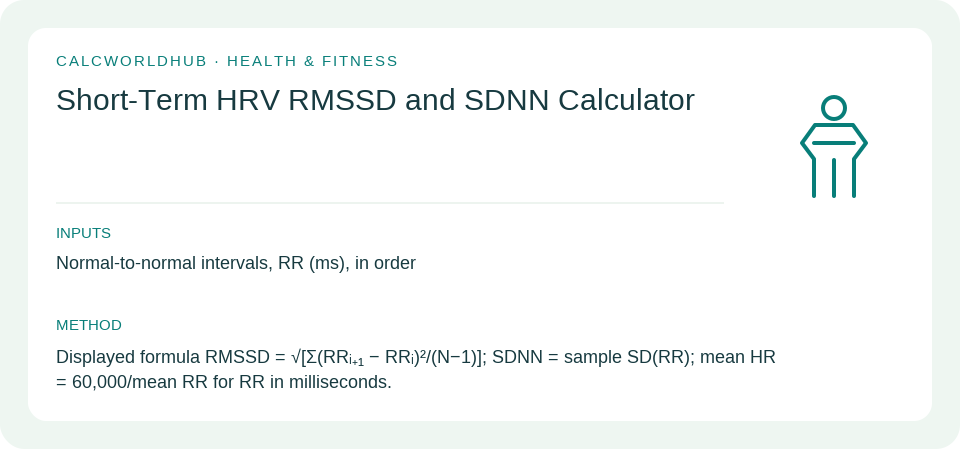
RMSSD = √[Σ(RRᵢ₊₁ − RRᵢ)²/(N−1)]; SDNN = sample SD(RR); mean HR = 60,000/mean RR for RR in milliseconds.
Method
Compute the root mean square of successive differences, the sample standard deviation using N−1 in the denominator, and heart rate from the mean interval. The entered sequence is treated as an already cleaned NN series.
Worked example
For NN intervals [800, 780, 810, 790, 805] ms, RMSSD ≈ 21.94 ms, sample SDNN ≈ 12.04 ms, and mean heart rate ≈ 75.28 beats/min.
Assumptions and limits
Use a consistent segment of normal-to-normal intervals with artifacts and ectopic beats handled by an appropriate recording workflow. This calculator does not clean ECG data, establish a recording-quality standard, or interpret results as a diagnosis or health threshold. SDNN depends on recording duration.
Frequently asked questions
What does RMSSD summarize?
It summarizes successive differences between adjacent normal-to-normal intervals.
What does SDNN summarize?
It is the sample standard deviation of the entered normal-to-normal interval series; its value depends on recording length.
Does this diagnose a heart condition?
No. It reports arithmetic time-domain measures and does not interpret them clinically.
How do I use the Short-Term HRV RMSSD and SDNN Calculator?
Enter Normal-to-normal intervals, RR (ms), in order. Match the units shown beside each field and review the result together with the assumptions below.
What is a worked example of Short-Term HRV RMSSD and SDNN?
For NN intervals [800, 780, 810, 790, 805] ms, RMSSD ≈ 21.94 ms, sample SDNN ≈ 12.04 ms, and mean heart rate ≈ 75.28 beats/min.
Reference: ESC/EHRA position statement definitions for SDNN and RMSSD. See our calculation methodology.