How to use this calculator
Find a minimum sample size and acceptance number that meet selected producer-risk and consumer-risk limits.
- Enter Acceptable quality level AQL (%), Lot tolerance percent defective LTPD (%), Producer's risk α (%), Consumer's risk β (%), then complete the remaining labeled fields. Match the units shown beside each field and review the result together with the assumptions below.
- Read the worked example below to check the expected input format and result.
- Compare another scenario by changing one input at a time. Use Reset to return to the starting values.
How this calculation works
A sampling plan design starts with two quality points: an acceptable quality level and a worse lot quality that the consumer wants to reject. The plan searches integer sample sizes and acceptance numbers so the binomial probability of acceptance meets both risk limits.
Inputs and units
aqlPercent— Acceptable quality level AQL (%)- Defective fraction at which the producer-risk constraint should be met.
ltpdPercent— Lot tolerance percent defective LTPD (%)- Worse defect fraction at which the consumer-risk constraint should be met; must exceed AQL.
producerRiskPercent— Producer's risk α (%)- Maximum allowed probability of rejecting a lot at the AQL.
consumerRiskPercent— Consumer's risk β (%)- Maximum allowed probability of accepting a lot at the LTPD.
maxSampleSize— Maximum sample size to search- Integer search ceiling. Increase this if no feasible plan is found.
Formula
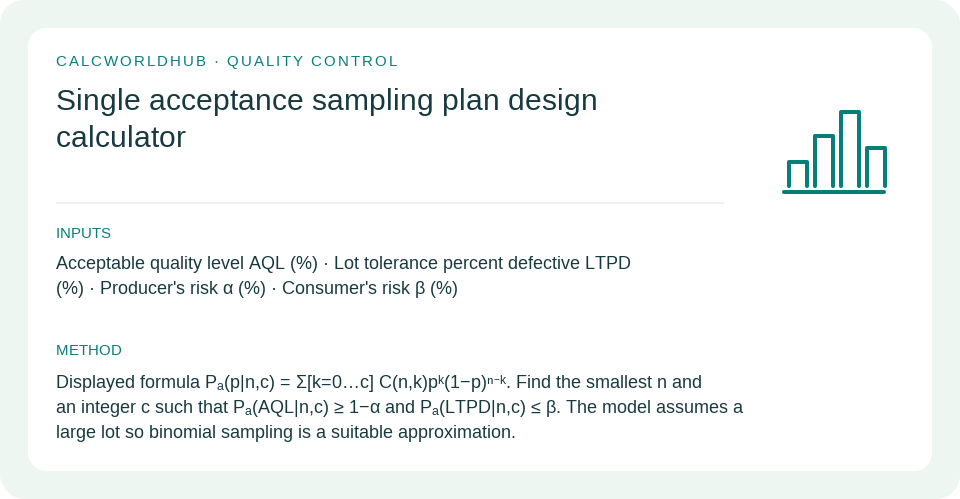
Pₐ(p|n,c) = Σ[k=0…c] C(n,k)pᵏ(1−p)ⁿ⁻ᵏ. Find the smallest n and an integer c such that Pₐ(AQL|n,c) ≥ 1−α and Pₐ(LTPD|n,c) ≤ β. The model assumes a large lot so binomial sampling is a suitable approximation.
Method
Enter AQL and LTPD as defect percentages, plus producer's risk α, consumer's risk β, and the largest sample size to search. The planner returns the first feasible integer pair (n,c), along with the achieved acceptance probabilities at both quality points.
Worked example
With AQL = 1%, LTPD = 10%, α = 5%, and β = 10%, the smallest binomial plan found is n = 52, c = 2. Its acceptance probabilities are about 98.465% at AQL and 9.663% at LTPD.
Assumptions and limits
This is an approximate binomial single-sampling design for large lots and independent random inspection. Finite-lot sampling may require a hypergeometric model; inspection severity, switching rules, standards tables, and measurement error are not included. Treat the result as an analytical starting point, not a substitute for a contractual or regulatory sampling standard.
Frequently asked questions
What do AQL and LTPD mean in this planner?
AQL is the quality point where the producer wants a high acceptance probability. LTPD is a worse quality point where the consumer wants a low acceptance probability.
How is the acceptance number used?
Accept the lot if the sample contains no more than c defectives; reject it if the count is greater than c.
Why does lot size not appear as an input?
The binomial approximation assumes a lot much larger than the sample. For smaller lots, an exact finite-population hypergeometric design may be needed.
How do I use the Single acceptance sampling plan design calculator?
Enter Acceptable quality level AQL (%), Lot tolerance percent defective LTPD (%), Producer's risk α (%), Consumer's risk β (%), then complete the remaining labeled fields. Match the units shown beside each field and review the result together with the assumptions below.
What is a worked example of Single acceptance sampling plan design?
With AQL = 1%, LTPD = 10%, α = 5%, and β = 10%, the smallest binomial plan found is n = 52, c = 2. Its acceptance probabilities are about 98.465% at AQL and 9.663% at LTPD.
Reference: NIST single-sampling-plan design method. See our calculation methodology.