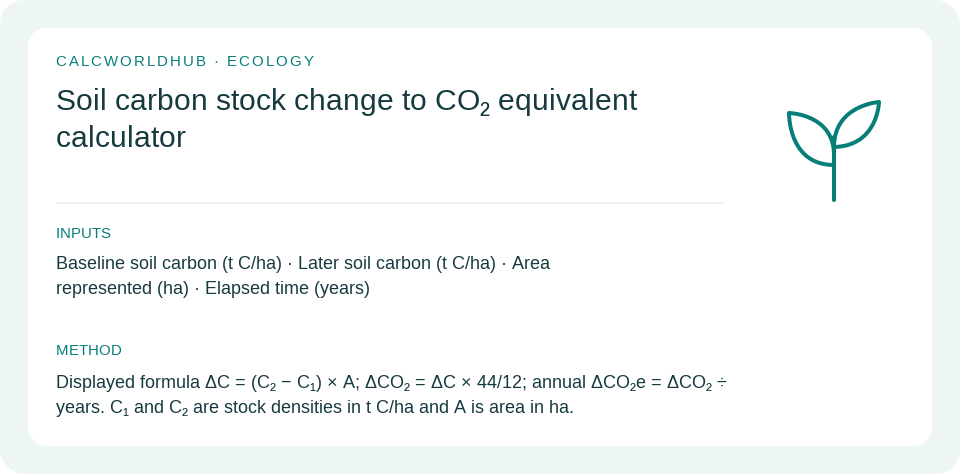
How to use this calculator
Convert a measured soil-carbon stock change over an area and time period into an annualized CO₂-equivalent quantity.
- Enter Baseline soil carbon (t C/ha), Later soil carbon (t C/ha), Area represented (ha), Elapsed time (years). Match the units shown beside each field and review the result together with the assumptions below.
- Read the worked example below to check the expected input format and result.
- Compare another scenario by changing one input at a time. Use Reset to return to the starting values.
How this calculation works
A soil-carbon stock is a measured quantity of carbon stored in a defined area and depth. Comparing two inventories can express the change as a carbon-dioxide mass equivalent using the molecular-mass ratio 44/12, then annualize that stock change over the interval between measurements.
Inputs and units
initialCarbonTha— Baseline soil carbon (t C/ha)- Carbon stock per hectare at the first measurement for the defined soil depth and boundary.
finalCarbonTha— Later soil carbon (t C/ha)- Comparable carbon stock density measured at the later date.
areaHa— Area represented (ha)- Area to which the stock-density change applies.
intervalYears— Elapsed time (years)- Time between the baseline and later inventories.
Formula
ΔC = (C₂ − C₁) × A; ΔCO₂ = ΔC × 44/12; annual ΔCO₂e = ΔCO₂ ÷ years. C₁ and C₂ are stock densities in t C/ha and A is area in ha.
Method
Enter baseline and later soil-carbon stock density, the matching land area, and elapsed years. The difference is converted from carbon mass to CO₂ mass with 44/12 and divided by the elapsed interval. Positive values indicate a larger measured carbon stock; negative values indicate a smaller stock.
Worked example
If stock density rises from 48 to 51 t C/ha over 12 ha in 5 years, the increase is 36 t C. Its CO₂ mass equivalent is 36 × 44/12 = 132 t CO₂, or 26.4 t CO₂ per year over the interval.
Assumptions and limits
The result is a stock-change equivalent, not a verified greenhouse-gas inventory, offset, or credit. Measurements must use comparable boundaries, depth, bulk-density treatment, and sampling methods. The calculation does not include methane, nitrous oxide, leakage, permanence, uncertainty, or project-accounting rules.
Frequently asked questions
Why is carbon multiplied by 44/12?
Carbon dioxide contains one carbon atom with mass 12 and two oxygen atoms for a total molecular mass of 44, so the mass ratio is 44/12.
Does a positive result prove an offset?
No. It reports only the arithmetic equivalent of the entered stock change; verification, uncertainty, permanence, and program rules are separate.
Can the two inventories use different soil depths?
They should represent comparable boundaries and depths. Otherwise the difference can reflect sampling design rather than a real stock change.
How do I use the Soil carbon stock change to CO₂ equivalent calculator?
Enter Baseline soil carbon (t C/ha), Later soil carbon (t C/ha), Area represented (ha), Elapsed time (years). Match the units shown beside each field and review the result together with the assumptions below.
What is a worked example of Soil carbon stock change to CO₂ equivalent?
If stock density rises from 48 to 51 t C/ha over 12 ha in 5 years, the increase is 36 t C. Its CO₂ mass equivalent is 36 × 44/12 = 132 t CO₂, or 26.4 t CO₂ per year over the interval.
Reference: technical reference. See our calculation methodology.