How to use this calculator
Calculate a soil shrinkage limit from wet-pat water content, dry mass, and measured wet and dry volumes.
- Enter Wet-pat water content, w (%), Oven-dry soil mass, Wₛ (g), Wet soil pat volume, V (cm³), Oven-dry soil pat volume, V_d (cm³). Match the units shown beside each field and review the result together with the assumptions below.
- Read the worked example below to check the expected input format and result.
- Compare another scenario by changing one input at a time. Use Reset to return to the starting values.
How this calculation works
Enter the gravimetric water content of the wet soil pat, its oven-dry mass, and the specimen volume before and after drying. The calculation subtracts the volume-change water equivalent from the initial water content to estimate the shrinkage limit.
Inputs and units
wetPatWaterContentPct— Wet-pat water content, w (%)- Gravimetric water content of the specimen before drying, expressed as percent of oven-dry soil mass.
drySoilMassG— Oven-dry soil mass, Wₛ (g)- Dry mass of the soil pat, excluding the shrinkage dish.
wetPatVolumeCm3— Wet soil pat volume, V (cm³)- Specimen volume before drying, measured using the selected shrinkage test method.
dryPatVolumeCm3— Oven-dry soil pat volume, V_d (cm³)- Volume of the oven-dry soil pat from displacement or the applicable standard test procedure.
Formula
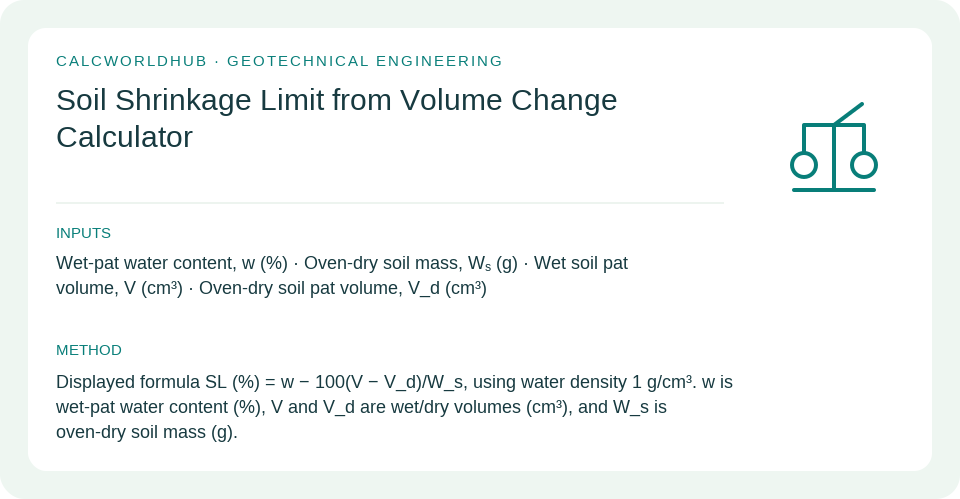
SL (%) = w − 100(V − V_d)/W_s, using water density 1 g/cm³. w is wet-pat water content (%), V and V_d are wet/dry volumes (cm³), and W_s is oven-dry soil mass (g).
Method
Compute the wet-to-dry specimen volume decrease, convert that volume of water to a gravimetric percentage of dry soil mass, then subtract it from the wet-pat water content. The output is the shrinkage limit in percent.
Worked example
For a wet-pat water content of 25%, oven-dry soil mass of 40 g, wet volume of 28 cm³, and dry volume of 20 cm³, the volume decrease is 8 cm³. The shrinkage limit is 25 − 100(8/40) = 5.00%.
Assumptions and limits
Use cohesive-soil specimen measurements from a suitable shrinkage test. This is a measurement-reduction calculation; it does not perform the test or verify sample preparation, volume displacement, or equipment. The ASTM water-submersion method has test-specific limits, and shrinkage limit alone is not a design parameter.
Frequently asked questions
What measurements does this formula use?
It uses wet-pat water content, oven-dry soil mass, wet specimen volume, and dry pat volume from a shrinkage-limit test.
Is shrinkage limit the same as plastic limit?
No. Shrinkage limit is a separate Atterberg boundary associated with volume change during drying; it is not the plastic limit.
Does this replace the laboratory procedure?
No. It reduces recorded measurements only. Sample preparation, displacement measurements, and test-method requirements still apply.
How do I use the Soil Shrinkage Limit from Volume Change Calculator?
Enter Wet-pat water content, w (%), Oven-dry soil mass, Wₛ (g), Wet soil pat volume, V (cm³), Oven-dry soil pat volume, V_d (cm³). Match the units shown beside each field and review the result together with the assumptions below.
What is a worked example of Soil Shrinkage Limit from Volume Change?
For a wet-pat water content of 25%, oven-dry soil mass of 40 g, wet volume of 28 cm³, and dry volume of 20 cm³, the volume decrease is 8 cm³. The shrinkage limit is 25 − 100(8/40) = 5.00%.
Reference: U.S. Army Corps of Engineers ENG Form 3839 shrinkage-limit measurement equation. See our calculation methodology.