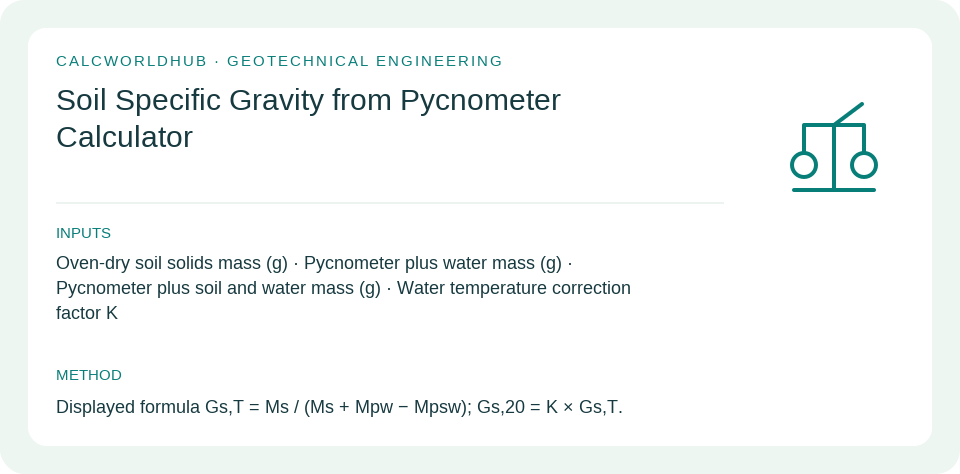
How to use this calculator
Estimate soil-solids specific gravity from dry sample and pycnometer mass readings.
- Enter Oven-dry soil solids mass (g), Pycnometer plus water mass (g), Pycnometer plus soil and water mass (g), Water temperature correction factor K. Match the units shown beside each field and review the result together with the assumptions below.
- Read the worked example below to check the expected input format and result.
- Compare another scenario by changing one input at a time. Use Reset to return to the starting values.
How this calculation works
A water pycnometer uses the change in water mass when a dry soil sample occupies part of the calibrated bottle volume. The displaced-water mass is the dry soil mass plus the pycnometer-and-water mass minus the pycnometer, soil, and water mass.
Inputs and units
drySoilMass— Oven-dry soil solids mass (g)- Mass of oven-dry soil solids, in grams.
pycnometerWaterMass— Pycnometer plus water mass (g)- Mass of the calibrated pycnometer filled with water at the test temperature, in grams.
pycnometerSoilWaterMass— Pycnometer plus soil and water mass (g)- Mass of the same pycnometer filled with dry soil and water at that test temperature, in grams.
waterCorrectionK— Water temperature correction factor K- Factor used to convert test-temperature specific gravity to the selected reference temperature; use 1 when no correction is needed.
Formula
Gs,T = Ms / (Ms + Mpw − Mpsw); Gs,20 = K × Gs,T.
Method
Enter the oven-dry soil mass, the pycnometer mass with water, the pycnometer mass with soil and water, and the water-temperature correction factor K. Use mass readings taken at the same test temperature and the correction factor from the applicable test procedure when reporting at 20°C.
Worked example
For 50.0 g of dry soil, a pycnometer-plus-water mass of 150.0 g, a pycnometer-plus-soil-and-water mass of 181.0 g, and K = 1.000, displaced water is 19.0 g and corrected soil-solids specific gravity is 2.6316.
Assumptions and limits
This calculator covers the mass-balance calculation for a water pycnometer only. It assumes the sample is oven dry, the bottle is calibrated, air is removed, the mass readings use the same pycnometer and temperature, and the proper correction factor is supplied. It does not replace the current laboratory test method or quality-control requirements.
Frequently asked questions
What are the three masses?
They are oven-dry soil, the calibrated pycnometer filled with water, and the same pycnometer filled with soil and water, all measured at the test temperature.
What does K correct?
It adjusts the test-temperature specific gravity to the chosen reference-water temperature using the correction factor specified by the test method.
Why must air be removed?
Trapped air changes the displaced-water mass and can bias the calculated solids volume.
How do I use the Soil Specific Gravity from Pycnometer Calculator?
Enter Oven-dry soil solids mass (g), Pycnometer plus water mass (g), Pycnometer plus soil and water mass (g), Water temperature correction factor K. Match the units shown beside each field and review the result together with the assumptions below.
What is a worked example of Soil Specific Gravity from Pycnometer?
For 50.0 g of dry soil, a pycnometer-plus-water mass of 150.0 g, a pycnometer-plus-soil-and-water mass of 181.0 g, and K = 1.000, displaced water is 19.0 g and corrected soil-solids specific gravity is 2.6316.
Reference: ASTM D854-23 specific gravity of soil solids by water displacement. See our calculation methodology.