How to use this calculator
Estimate how much soil pore space contains water from water content, particle specific gravity, and void ratio.
- Enter Gravimetric water content (%), Specific gravity of soil solids (Gₛ), Void ratio (e). Match the units shown beside each field and review the result together with the assumptions below.
- Read the worked example below to check the expected input format and result.
- Compare another scenario by changing one input at a time. Use Reset to return to the starting values.
How this calculation works
Soil degree of saturation describes the share of void volume occupied by water. This tool converts gravimetric water content to a decimal and combines it with the solids' specific gravity and the void ratio; it also reports the remaining air-filled share and the water content corresponding to saturation.
Inputs and units
waterContentPct— Gravimetric water content (%)- Enter water mass divided by dry-solids mass, expressed as a percent.
specificGravity— Specific gravity of soil solids (Gₛ)- Use the dimensionless particle specific gravity, not dry bulk density.
voidRatio— Void ratio (e)- Use void volume divided by solid-particle volume.
Formula
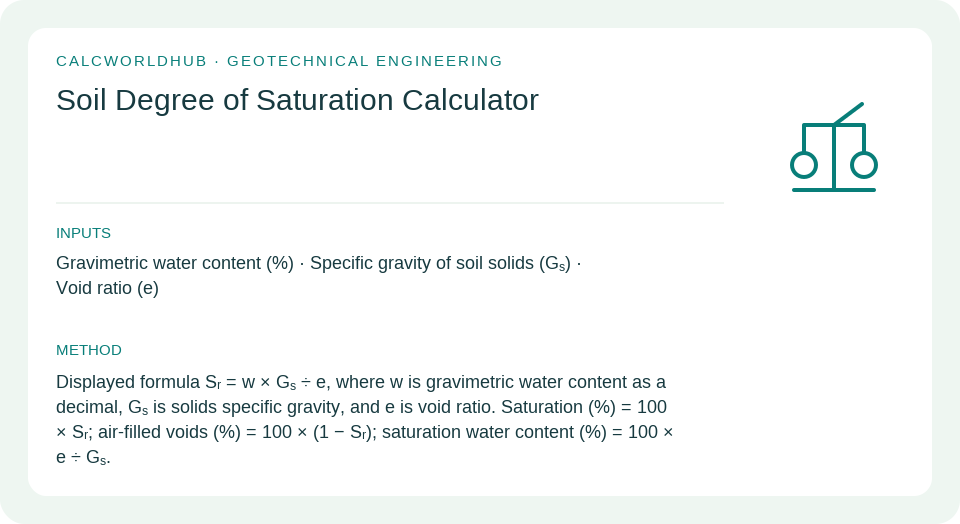
Sᵣ = w × Gₛ ÷ e, where w is gravimetric water content as a decimal, Gₛ is solids specific gravity, and e is void ratio. Saturation (%) = 100 × Sᵣ; air-filled voids (%) = 100 × (1 − Sᵣ); saturation water content (%) = 100 × e ÷ Gₛ.
Method
Enter water content as a percentage by dry soil mass, the dimensionless specific gravity of the solids, and the dimensionless void ratio. The calculation uses the standard soil-phase relationship and rejects combinations that imply more than 100% saturation.
Worked example
With w = 18%, Gₛ = 2.70, and e = 0.75, Sᵣ = 0.18 × 2.70 ÷ 0.75 = 0.648, or 64.8%; the remaining 35.2% of the void volume is air.
Assumptions and limits
The relationship assumes compatible measurements for the same soil state and the usual soil-mechanics definitions of water content, void ratio, and particle specific gravity. Swelling, shrinkage, measurement error, or incompatible sample states can make the inputs inconsistent; this estimate is not a field classification by itself.
Frequently asked questions
Is water content entered as a decimal or percent?
Enter it as a percent, such as 18. The calculator converts that value to 0.18 inside the equation.
Can the calculated saturation exceed 100%?
A physical degree of saturation cannot exceed 100%. If the relationship returns a larger value, the entered measurements or their definitions are inconsistent.
What does the air-filled percentage represent?
It is the portion of the void volume not occupied by water, calculated as 100% minus degree of saturation.
Is this a substitute for a laboratory test?
No. It derives a phase relationship from entered measurements and does not validate how those measurements were obtained.
How do I use the Soil Degree of Saturation Calculator?
Enter Gravimetric water content (%), Specific gravity of soil solids (Gₛ), Void ratio (e). Match the units shown beside each field and review the result together with the assumptions below.
Reference: Soil-mechanics phase-relationship equations for water content, void ratio, and saturation. See our calculation methodology.