How to use this calculator
Estimate unsaturated soil water content and hydraulic conductivity from fitted van Genuchten–Mualem parameters.
- Enter Residual volumetric water content, θr, Saturated volumetric water content, θs, van Genuchten α, inverse metres, van Genuchten n, then complete the remaining labeled fields. Match the units shown beside each field and review the result together with the assumptions below.
- Read the worked example below to check the expected input format and result.
- Compare another scenario by changing one input at a time. Use Reset to return to the starting values.
How this calculation works
The van Genuchten model maps positive suction head to effective saturation and volumetric water content. Combining it with Mualem’s pore-size model gives a relative hydraulic conductivity curve. The common restriction m = 1 − 1/n yields a compact conductivity equation; the pore-connectivity parameter l is often set to 0.5 when no soil-specific fit is available.
Inputs and units
thetaResidual— Residual volumetric water content, θr- Use a fraction from 0 to 1, in m³/m³.
thetaSaturated— Saturated volumetric water content, θs- Use a fraction from 0 to 1; it must exceed θr.
alpha— van Genuchten α, inverse metres- Enter α in m⁻¹ when suction head is entered in metres.
n— van Genuchten n- The constrained model requires n greater than 1.
suctionHead— Positive suction head, metres- Enter the magnitude of suction head; saturated conditions are h = 0.
saturatedK— Saturated hydraulic conductivity Ks, metres per day- Use metres per day; the output K uses the same time and length units.
connectivity— Mualem pore-connectivity parameter l- A common default is 0.5; use a fitted value when available.
Formula
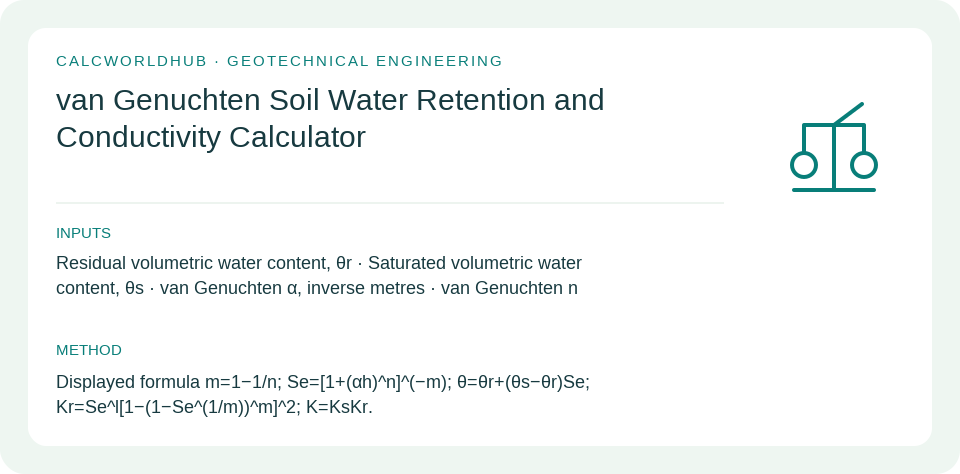
m=1−1/n; Se=[1+(αh)^n]^(−m); θ=θr+(θs−θr)Se; Kr=Se^l[1−(1−Se^(1/m))^m]^2; K=KsKr.
Method
Use the fitted residual and saturated volumetric water contents, inverse-length α, pore-size parameter n, and positive suction head h to calculate effective saturation and θ. Apply the Mualem conductivity closure with the entered saturated conductivity Ks and pore-connectivity parameter l.
Worked example
With θr = 0.05, θs = 0.45, α = 1.6 m⁻¹, n = 1.4, suction head 1 m, Ks = 0.3 m/day and l = 0.5, the calculator reports effective saturation, volumetric water content and the corresponding unsaturated conductivity.
Assumptions and limits
This estimates a soil hydraulic curve from parameters already fitted for that soil; it does not infer parameters from samples. Use consistent length units for α, h, and Ks. The standard m = 1 − 1/n restriction is assumed, and the model does not represent hysteresis, layering, preferential flow, or salinity effects.
Frequently asked questions
What is the sign convention for suction head?
Enter its positive magnitude. The model takes h = 0 at saturation and positive values for unsaturated soil.
Why is m set to 1 − 1/n?
That standard restriction gives the compact van Genuchten–Mualem conductivity form. Some fitted models estimate m independently, which this calculator does not support.
Can these parameters be transferred to another soil?
No. α, n, θr, θs, and Ks describe the fitted soil sample or horizon; use measured or defensibly fitted values for the soil being modeled.
How do I use the van Genuchten Soil Water Retention and Conductivity Calculator?
Enter Residual volumetric water content, θr, Saturated volumetric water content, θs, van Genuchten α, inverse metres, van Genuchten n, then complete the remaining labeled fields. Match the units shown beside each field and review the result together with the assumptions below.
What is a worked example of van Genuchten Soil Water Retention and Conductivity?
With θr = 0.05, θs = 0.45, α = 1.6 m⁻¹, n = 1.4, suction head 1 m, Ks = 0.3 m/day and l = 0.5, the calculator reports effective saturation, volumetric water content and the corresponding unsaturated conductivity.
Reference: U.S. EPA pollutant loading and wastewater flow methodology. See our calculation methodology.