How to use this calculator
Estimate sand-corrected water-stable aggregate mass as a percentage of the dry soil sample.
- Enter Initial dry soil sample mass (g), Dry mass retained after wet sieving (g), Sand correction mass (g). Match the units shown beside each field and review the result together with the assumptions below.
- Read the worked example below to check the expected input format and result.
- Compare another scenario by changing one input at a time. Use Reset to return to the starting values.
How this calculation works
This wet-sieving result corrects both the retained dry material and the original dry soil sample for sand that remains after dispersion. Use masses from the same sample and a consistent sieve fraction and laboratory or field method.
Inputs and units
initialDrySoilMass— Initial dry soil sample mass (g)- Dry soil mass before the wet-sieving test.
dryMassRetainedAfterWetSieving— Dry mass retained after wet sieving (g)- Dry mass remaining on the sieve after wet sieving, including sand later removed by correction.
sandCorrectionMass— Sand correction mass (g)- Mass of sand that remained after dispersal and must be subtracted from both masses.
Formula
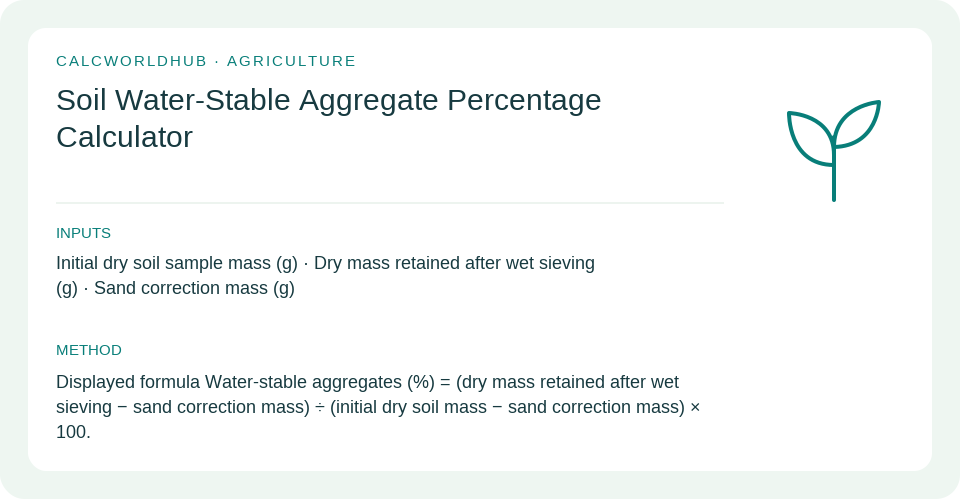
Water-stable aggregates (%) = (dry mass retained after wet sieving − sand correction mass) ÷ (initial dry soil mass − sand correction mass) × 100.
Method
Enter the dry sample mass, dry mass retained after wet sieving, and the retained sand mass determined after dispersion. Keep the sieve fraction and sample preparation consistent across comparisons.
Worked example
For a 50 g dry soil sample, 32 g retained after wet sieving, and 4 g of sand correction, corrected water-stable aggregate mass is 28 g and the water-stable aggregate percentage is 60.87%.
Assumptions and limits
The value depends on the selected wet-sieving method and size fraction. It is a method-specific soil structural indicator, not a universal soil-health grade.
Frequently asked questions
Why subtract sand?
Sand can remain on the sieve after dispersal without being a water-stable soil aggregate, so the method removes it from both masses.
Which sieve size should I use?
Use the size fraction specified by your chosen wet-sieving protocol and compare only results from consistent methods.
Is a higher result always better?
Interpret it in the context of soil type, sampling depth, size fraction, and test method.
How do I use the Soil Water-Stable Aggregate Percentage Calculator?
Enter Initial dry soil sample mass (g), Dry mass retained after wet sieving (g), Sand correction mass (g). Match the units shown beside each field and review the result together with the assumptions below.
What is a worked example of Soil Water-Stable Aggregate Percentage?
For a 50 g dry soil sample, 32 g retained after wet sieving, and 4 g of sand correction, corrected water-stable aggregate mass is 28 g and the water-stable aggregate percentage is 60.87%.
Reference: USDA NRCS water-stable soil aggregate calculation. See our calculation methodology.