How to use this calculator
Estimate the fraction of the apparent solar disk covered from Sun and Moon angular diameters and their center separation.
- Enter Apparent Sun diameter (arcseconds), Apparent Moon diameter (arcseconds), Center-to-center separation (arcseconds). Match the units shown beside each field and review the result together with the assumptions below.
- Read the worked example below to check the expected input format and result.
- Compare another scenario by changing one input at a time. Use Reset to return to the starting values.
How this calculation works
Eclipse obscuration is an area fraction: it measures how much of the apparent solar disk is covered, not the fraction of the Sun’s diameter crossed. The calculator treats the Sun and Moon as circular disks at one instant and computes their geometric overlap.
Inputs and units
sun— Apparent Sun diameter (arcseconds)- Angular diameter of the solar disk at the moment being considered.
moon— Apparent Moon diameter (arcseconds)- Angular diameter of the lunar disk using the same angular unit.
separation— Center-to-center separation (arcseconds)- Angular distance between the apparent centers of the two disks.
Formula
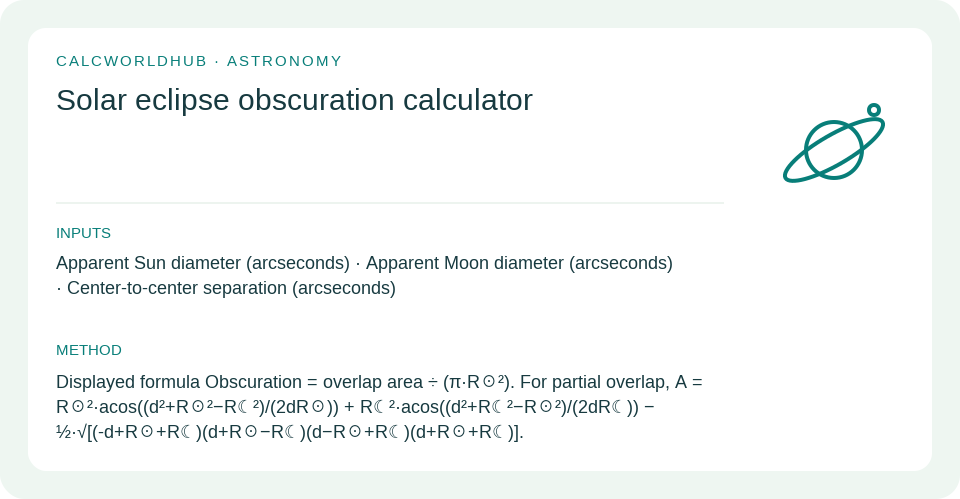
Obscuration = overlap area ÷ (π·R☉²). For partial overlap, A = R☉²·acos((d²+R☉²−R☾²)/(2dR☉)) + R☾²·acos((d²+R☾²−R☉²)/(2dR☾)) − ½·√[(-d+R☉+R☾)(d+R☉−R☾)(d−R☉+R☾)(d+R☉+R☾)].
Method
Enter apparent angular diameters for the Sun and Moon and the angular separation between their centers in the same unit, such as arcseconds. The overlap is zero when the disks do not touch and equals the smaller disk’s area when it is fully inside the larger disk.
Worked example
With a 1,920 arcsecond Sun, a 1,980 arcsecond Moon, and 300 arcseconds between their centers, the disks overlap partially. Their overlap area is about 82.9463% of the solar disk, so the obscuration result is 0.829463 at that instant.
Assumptions and limits
This is a geometric snapshot, not an eclipse prediction. It does not calculate time, location, lunar limb topography, atmospheric effects, or the path on Earth. Never look at the Sun without appropriate certified solar viewing protection, including during a partial eclipse.
Frequently asked questions
Is obscuration the same as eclipse magnitude?
No. Obscuration is the covered fraction of solar disk area; eclipse magnitude describes the fraction of the Sun’s apparent diameter obscured.
Can this tell me where an eclipse will be visible?
No. Visibility and timing require an ephemeris and observer location; this tool only evaluates supplied apparent disks at one instant.
Is it safe to view a partial eclipse without glasses?
No. Use appropriate certified solar viewers whenever any bright part of the Sun is visible; ordinary sunglasses are not a substitute.
How do I use the Solar eclipse obscuration calculator?
Enter Apparent Sun diameter (arcseconds), Apparent Moon diameter (arcseconds), Center-to-center separation (arcseconds). Match the units shown beside each field and review the result together with the assumptions below.
What is a worked example of Solar eclipse obscuration?
With a 1,920 arcsecond Sun, a 1,980 arcsecond Moon, and 300 arcseconds between their centers, the disks overlap partially. Their overlap area is about 82.9463% of the solar disk, so the obscuration result is 0.829463 at that instant.
Reference: NASA solar-eclipse glossary for magnitude and obscuration. See our calculation methodology.