How to use this calculator
Estimate the Sun’s declination from day of year and UTC hour using NOAA’s compact annual approximation.
- Enter Day of year (1–366), UTC hour (0–24). Match the units shown beside each field and review the result together with the assumptions below.
- Read the worked example below to check the expected input format and result.
- Compare another scenario by changing one input at a time. Use Reset to return to the starting values.
How this calculation works
Solar declination is the Sun’s angular position north or south of the celestial equator. Solar geometry and shadow studies often need this angle before calculating altitude or daylight.
Inputs and units
day— Day of year (1–366)- Ordinal calendar day, with January 1 as day 1.
hour— UTC hour (0–24)- Decimal UTC hour; 12.5 means 12:30 UTC.
Formula
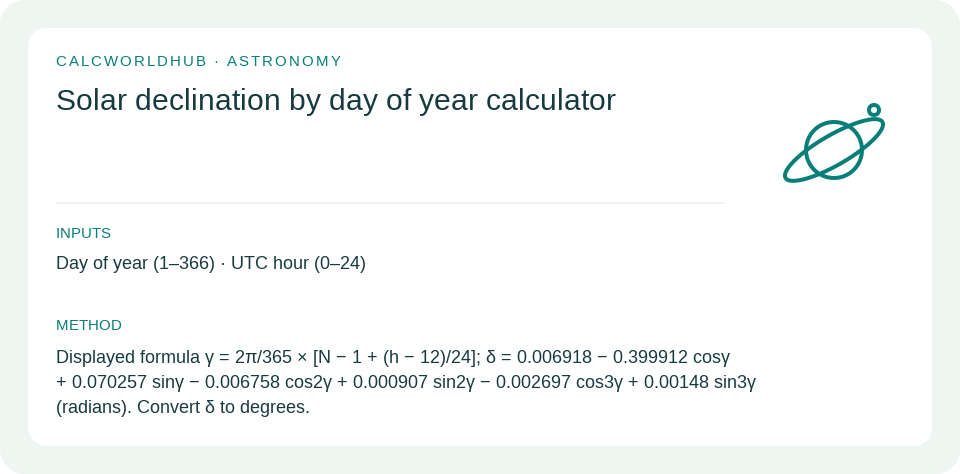
γ = 2π/365 × [N − 1 + (h − 12)/24]; δ = 0.006918 − 0.399912 cosγ + 0.070257 sinγ − 0.006758 cos2γ + 0.000907 sin2γ − 0.002697 cos3γ + 0.00148 sin3γ (radians). Convert δ to degrees.
Method
N is the ordinal day and h is UTC decimal hour. The NOAA series returns declination in radians; the calculator converts to degrees and reports the north/south direction.
Worked example
On day 172 at 12:00 UTC, the NOAA approximation gives solar declination of about +23.45°, north of the celestial equator.
Assumptions and limits
This compact seasonal approximation is not a full ephemeris. The 365-day harmonic can be slightly less accurate around leap days and year boundaries. It omits atmospheric refraction and does not calculate local altitude, sunrise, or sunset.
Frequently asked questions
What does positive solar declination mean?
The Sun is north of the celestial equator; a negative value places it south.
Does this calculate sunrise time?
No. It returns only declination. Sunrise also depends on latitude, longitude, date, time zone, and horizon convention.
Why does the formula use a 365-day cycle?
It is a compact annual approximation. A precise ephemeris handles leap years, orbital perturbations, and exact observation time more carefully.
How do I use the Solar declination by day of year calculator?
Enter Day of year (1–366), UTC hour (0–24). Match the units shown beside each field and review the result together with the assumptions below.
What is a worked example of Solar declination by day of year?
On day 172 at 12:00 UTC, the NOAA approximation gives solar declination of about +23.45°, north of the celestial equator.
Reference: NOAA Global Monitoring Laboratory solar position equations. See our calculation methodology.