How to use this calculator
Project annual and cumulative solar generation from a first-year yield and an assumed yearly degradation rate.
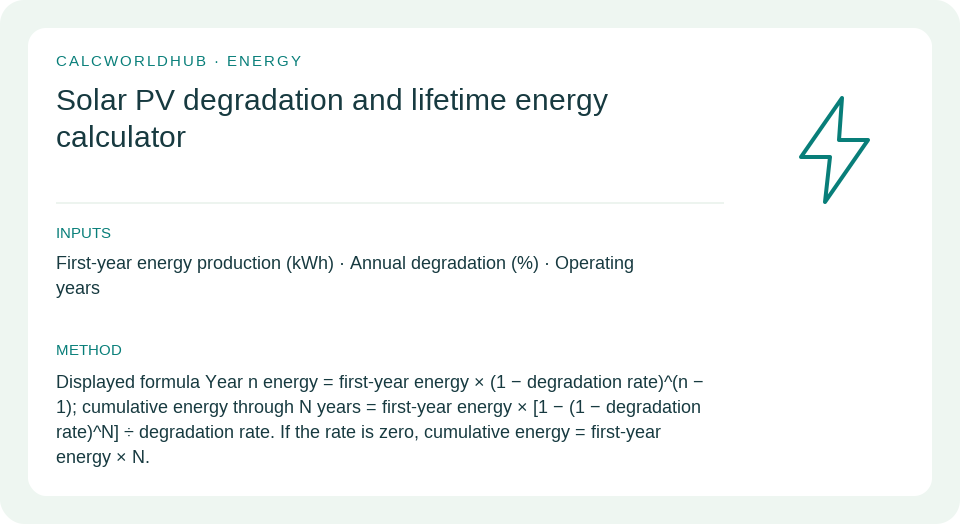
- Enter First-year energy production (kWh), Annual degradation (%), Operating years. Match the units shown beside each field and review the result together with the assumptions below.
- Read the worked example below to check the expected input format and result.
- Compare another scenario by changing one input at a time. Use Reset to return to the starting values.
How this calculation works
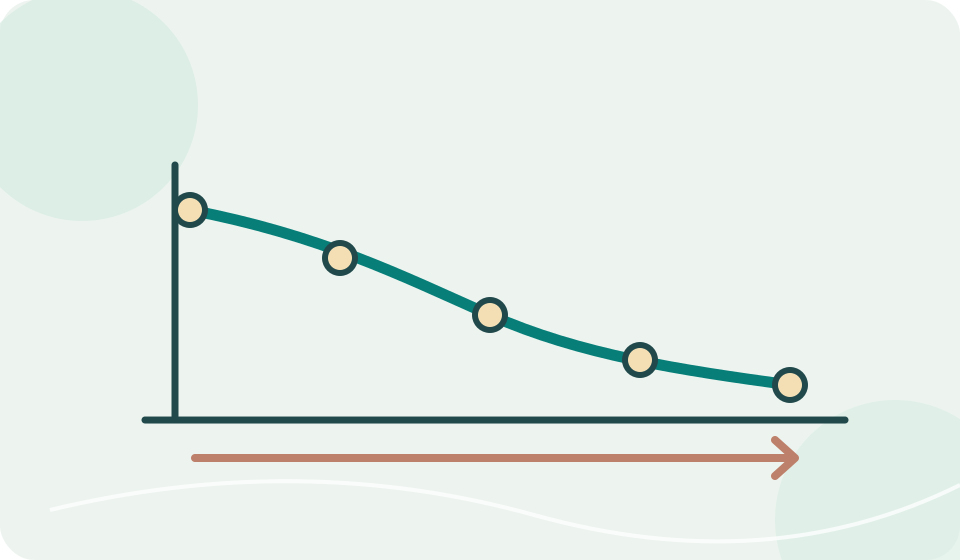
A photovoltaic system may produce less energy over time as its modules and other components age. This projection applies a constant fractional reduction to each year's production, making the result a planning scenario rather than a measured performance forecast.
Inputs and units
firstYearEnergy— First-year energy production (kWh)- Use expected or measured AC energy for the first operating year.
degradationPercent— Annual degradation (%)- Enter the fractional annual decrease as a percentage; 0 means no modeled degradation.
years— Operating years- Count year 1 as the entered baseline year.
Formula
Year n energy = first-year energy × (1 − degradation rate)^(n − 1); cumulative energy through N years = first-year energy × [1 − (1 − degradation rate)^N] ÷ degradation rate. If the rate is zero, cumulative energy = first-year energy × N.
Method
Enter expected or measured first-year energy, an annual degradation percentage, and operating years. Year 1 uses the entered first-year yield; each following year is reduced by the same fraction. The cumulative result sums those annual values.
Worked example
With 8,000 kWh in year 1 and 0.5% annual degradation, year 10 is 8,000 × 0.995^9 = 7,647.12 kWh; cumulative production across 10 years is about 78,223.79 kWh.
Assumptions and limits
The model assumes one constant fractional decline and no downtime, replacement, shading change, soiling variation, or weather trend. Actual production varies with site conditions; use it as a scenario, not a guarantee.
Frequently asked questions
Does the entered year count include the first year?
Yes. Year 1 is the entered baseline production; the selected year is reduced once for each year after year 1.
What does the degradation percentage represent?
It is the assumed fractional decline in annual energy from one year to the next, applied consistently in this model.
Does this predict my system's actual lifetime output?
No. It excludes site weather, soiling, outages, maintenance, component replacement, and other changes that affect measured generation.
How do I use the Solar PV degradation and lifetime energy calculator?
Enter First-year energy production (kWh), Annual degradation (%), Operating years. Match the units shown beside each field and review the result together with the assumptions below.
What is a worked example of Solar PV degradation and lifetime energy?
With 8,000 kWh in year 1 and 0.5% annual degradation, year 10 is 8,000 × 0.995^9 = 7,647.12 kWh; cumulative production across 10 years is about 78,223.79 kWh.
Reference: NREL PV performance report. See our calculation methodology.