How to use this calculator
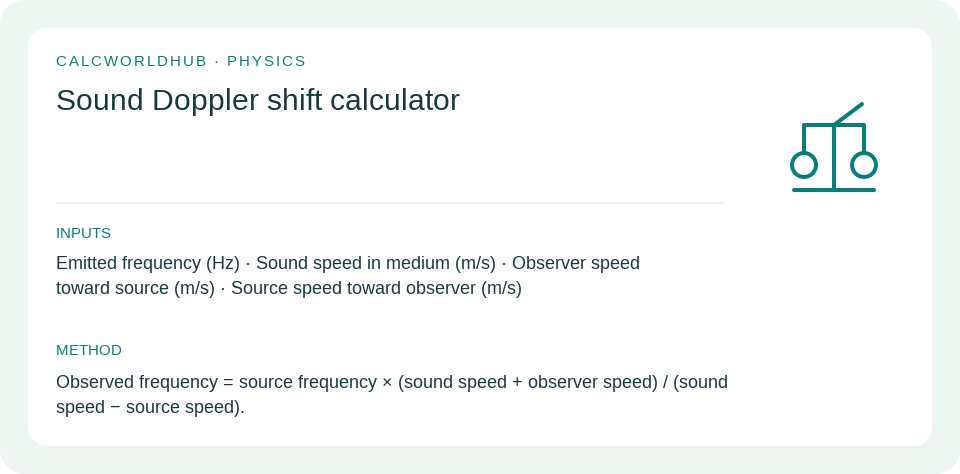
Estimate a one-dimensional acoustic Doppler shift for a moving source and observer relative to a stationary medium.
- Enter Emitted frequency (Hz), Sound speed in medium (m/s), Observer speed toward source (m/s), Source speed toward observer (m/s). Match the units shown beside each field and review the result together with the assumptions below.
- Read the worked example below to check the expected input format and result.
- Compare another scenario by changing one input at a time. Use Reset to return to the starting values.
Sound Doppler shift explained
The observed frequency depends on wave speed relative to both moving observer and source; keep velocity signs consistent with the page’s toward/away convention.
How the calculation works
Observed frequency = source frequency × (sound speed + observer speed) / (sound speed − source speed).
Inputs and units
- Emitted frequency (Hz)
- Source frequency in the medium frame.
- Sound speed in medium (m/s)
- Propagation speed for the stated medium conditions.
- Observer speed toward source (m/s)
- Positive when moving toward the source.
- Source speed toward observer (m/s)
- Positive when moving toward the observer.
Limits of this model
Only collinear subsonic motion is accepted. Wind, refraction, relativistic light shifts, and shock waves are excluded.
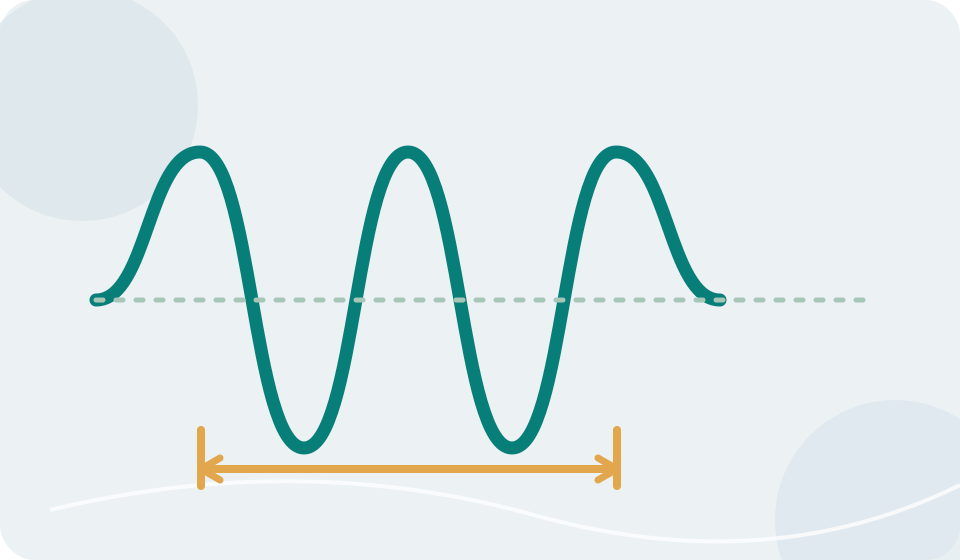
Wave speed links frequency and wavelength. Doppler shift changes the observed frequency through relative source and observer motion.
Check a numerical scenario
Emitted frequency (Hz) = 440; Sound speed in medium (m/s) = 343; Observer speed toward source (m/s) = 10; Source speed toward observer (m/s) = 20.
- Observed frequency: 480.8669 Hz
At 343 m/s sound speed, the entered observer and source velocities produce an observed frequency of about 480.87 Hz from 440 Hz.
Frequently asked questions
How do I enter motion away?
Use a negative velocity for that source or observer.
Can I use this for light?
No. Light requires a relativistic Doppler model.
Does sound speed depend on the medium?
Yes. Enter the speed appropriate to the actual medium and conditions.
How do I use the Sound Doppler shift calculator?
Enter Emitted frequency (Hz), Sound speed in medium (m/s), Observer speed toward source (m/s), Source speed toward observer (m/s). Match the units shown beside each field and review the result together with the assumptions below.
What is a worked example of Sound Doppler shift?
Emitted frequency (Hz) = 440; Sound speed in medium (m/s) = 343; Observer speed toward source (m/s) = 10; Source speed toward observer (m/s) = 20. Observed frequency: 480.8669 Hz At 343 m/s sound speed, the entered observer and source velocities produce an observed frequency of about 480.87 Hz from 440 Hz.
See our calculation methodology.