How to use this calculator
Use completed story points from prior sprints to estimate average velocity and a rough backlog timeline.
- Enter Completed story points per past sprint, Remaining backlog (story points). Match the units shown beside each field and review the result together with the assumptions below.
- Read the worked example below to check the expected input format and result.
- Compare another scenario by changing one input at a time. Use Reset to return to the starting values.
How this calculation works
Velocity is an observed team-specific rate: add the estimates for work accepted as complete in each sprint. This forecast divides the remaining backlog by the mean of those completed-sprint totals; it is a planning aid, not a delivery commitment.
Inputs and units
completedPoints— Completed story points per past sprint- Enter one nonnegative whole-number total for each completed sprint, separated by commas.
backlogPoints— Remaining backlog (story points)- Use the same point scale as the historical sprint totals.
Formula
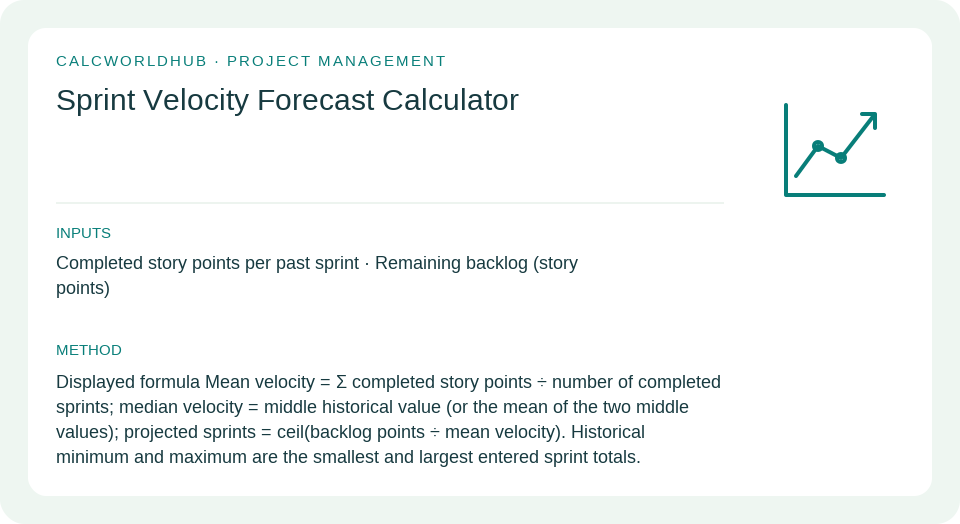
Mean velocity = Σ completed story points ÷ number of completed sprints; median velocity = middle historical value (or the mean of the two middle values); projected sprints = ceil(backlog points ÷ mean velocity). Historical minimum and maximum are the smallest and largest entered sprint totals.
Method
Enter one completed-point total per past sprint and the remaining backlog in the same team-specific point scale. Only completed work belongs in the historical totals. The displayed sprint count rounds up to a whole sprint.
Worked example
For completed sprint totals of 22, 18, 25, 20, and 15 points, the mean is 20 points per sprint. A remaining 60-point backlog therefore takes about ceil(60/20) = 3 sprints at that average pace.
Assumptions and limits
Story points are local estimates, not comparable units between teams. The forecast assumes future delivery resembles the entered sprints and does not model scope changes, holidays, staffing, or uncertainty.
Frequently asked questions
Which sprint totals should I enter?
Use the points for items accepted as complete during each sprint, not the planned points or partially finished work.
Can I compare velocity between teams?
No. Story-point scales are team-specific, so this average is most useful for the same team and estimation practice.
Why does the forecast round up?
A fraction of a sprint still requires another sprint planning interval, so the displayed estimate is rounded to a whole sprint.
Does this guarantee the backlog finish date?
No. It is a simple historical-rate estimate and does not account for changing scope or future capacity.
How do I use the Sprint Velocity Forecast Calculator?
Enter Completed story points per past sprint, Remaining backlog (story points). Match the units shown beside each field and review the result together with the assumptions below.
Reference: Agile Alliance guide to estimation and empirical forecasting. See our calculation methodology.