How to use this calculator
Compare current sprint work remaining with an ideal burndown line and calculate the pace needed to finish on time.
- Enter Starting sprint scope (work units), Work added since sprint start, Work removed since sprint start, Work completed so far, then complete the remaining labeled fields. Match the units shown beside each field and review the result together with the assumptions below.
- Read the worked example below to check the expected input format and result.
- Compare another scenario by changing one input at a time. Use Reset to return to the starting values.
How this calculation works
A burndown view tracks work left as a sprint progresses. This calculator adjusts the starting scope for additions and removals, subtracts completed work, and compares actual remaining work with a straight-line ideal. It also reports the average completion pace needed over the remaining workdays.
Inputs and units
startingScope— Starting sprint scope (work units)- Total planned work at sprint start, using hours, points, or another single unit.
scopeAdded— Work added since sprint start- Work added to the sprint after planning, in the same unit.
scopeRemoved— Work removed since sprint start- Work taken out of the original scope, in the same unit.
completedWork— Work completed so far- Completed work counted in the same estimation unit.
elapsedDays— Elapsed sprint workdays- Workdays completed so far, from zero through the sprint length.
sprintDays— Total sprint workdays- Total planned workdays in this sprint.
Formula
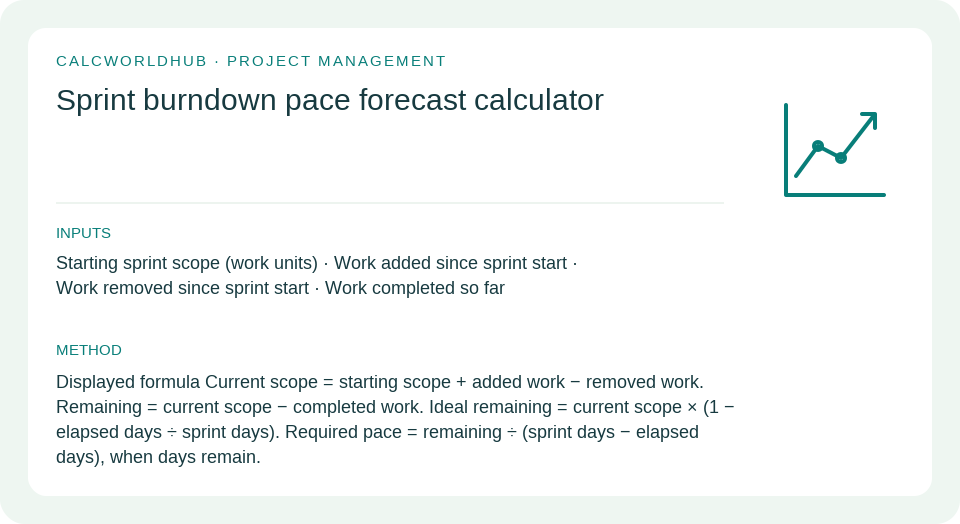
Current scope = starting scope + added work − removed work. Remaining = current scope − completed work. Ideal remaining = current scope × (1 − elapsed days ÷ sprint days). Required pace = remaining ÷ (sprint days − elapsed days), when days remain.
Method
Use one consistent work unit, such as hours or story points, for all scope inputs. Enter elapsed working days and total working days in the sprint. The forecast is a rate comparison; it does not predict individual task completion or future scope changes.
Worked example
For 50 starting points, 4 added, 2 removed, and 24 completed by day 4 of a 10-day sprint, adjusted scope is 52 and 28 points remain. The ideal line has 31.2 remaining; finishing requires 28 ÷ 6 = 4.67 points per remaining workday.
Assumptions and limits
The ideal line assumes work is completed evenly across the sprint, which real teams rarely do day by day. Scope changes, blocked work, estimation differences, and calendar choices affect the comparison. This tool does not convert hours to story points or estimate a team’s future velocity.
Frequently asked questions
What does a positive actual-minus-ideal value mean?
More work remains than the straight-line ideal at the entered day, so the actual burndown is behind that reference line.
Can I use hours instead of story points?
Yes, as long as starting scope, scope changes, completed work, and outputs all use the same unit.
Does the required pace guarantee the sprint goal?
No. It is an arithmetic average over remaining workdays; dependencies, scope changes, and work variability can change the outcome.
How do I use the Sprint burndown pace forecast calculator?
Enter Starting sprint scope (work units), Work added since sprint start, Work removed since sprint start, Work completed so far, then complete the remaining labeled fields. Match the units shown beside each field and review the result together with the assumptions below.
What is a worked example of Sprint burndown pace forecast?
For 50 starting points, 4 added, 2 removed, and 24 completed by day 4 of a 10-day sprint, adjusted scope is 52 and 28 points remain. The ideal line has 31.2 remaining; finishing requires 28 ÷ 6 = 4.67 points per remaining workday.
Reference: Atlassian sprint burndown documentation. See our calculation methodology.