How to use this calculator
Estimate earned schedule, time variance, time-based performance, and a completion-duration forecast from project status values.
- Enter Earned value EV, Budget at completion BAC, Planned duration SAC (months), Elapsed project time AT (months). Match the units shown beside each field and review the result together with the assumptions below.
- Read the worked example below to check the expected input format and result.
- Compare another scenario by changing one input at a time. Use Reset to return to the starting values.
How this calculation works
Cost-based schedule variance is expressed in budget units, which can be hard to translate into calendar impact. Earned Schedule maps earned value onto a linear planned-value baseline to express schedule position in time units and provide a simple duration forecast.
Inputs and units
earnedValue— Earned value EV- Budgeted value of completed work, in the same currency as BAC.
budgetAtCompletion— Budget at completion BAC- Total approved project budget, in the same currency as earned value.
scheduleAtCompletion— Planned duration SAC (months)- Baseline total project duration, in months for this example and your selected project time unit.
actualTime— Elapsed project time AT (months)- Duration from project start through the status date, using the same unit as SAC.
Formula
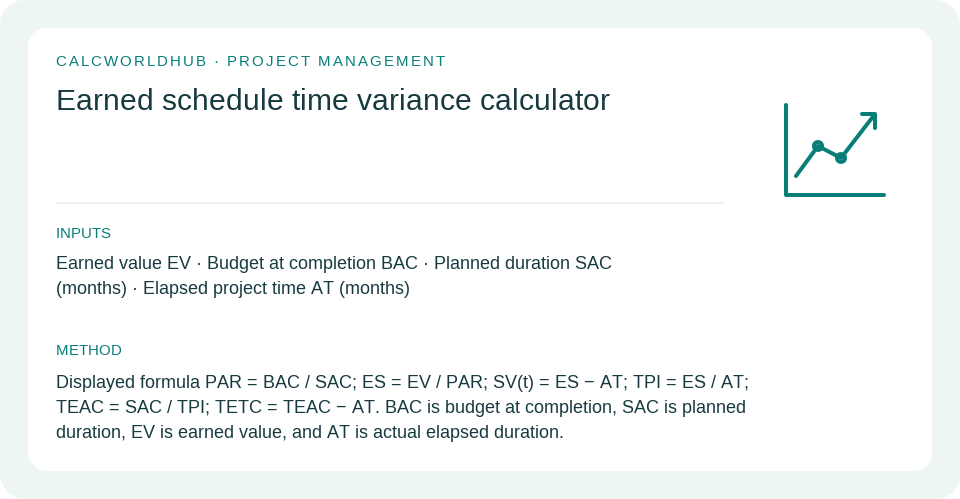
PAR = BAC / SAC; ES = EV / PAR; SV(t) = ES − AT; TPI = ES / AT; TEAC = SAC / TPI; TETC = TEAC − AT. BAC is budget at completion, SAC is planned duration, EV is earned value, and AT is actual elapsed duration.
Method
Enter earned value and total project budget in the same currency, plus planned and elapsed time in the same duration unit. This version uses the constant planned-accomplishment-rate approximation PAR = BAC/SAC, rather than interpolating a non-linear planned-value curve.
Worked example
With EV = $420,000, BAC = $1,200,000, SAC = 12 months, and AT = 5.5 months, PAR is $100,000/month, ES is 4.2 months, SV(t) is −1.3 months, TPI is 0.7636, and TEAC is about 15.71 months.
Assumptions and limits
The time forecast assumes the average earned-schedule performance observed so far continues. A linear planned-value profile is an approximation; projects with a strongly non-linear baseline should interpolate the actual cumulative planned-value curve. It does not replace critical-path analysis.
Frequently asked questions
How is earned schedule different from schedule variance?
Traditional earned-value schedule variance EV−PV is measured in budget units. SV(t) compares earned schedule with elapsed time and is expressed in the project's time unit.
Why does this calculator use a linear plan?
It converts BAC and baseline duration into one average planned-value rate. A non-linear baseline needs its planned-value curve and interpolation at the earned value.
What does a time performance index below 1 mean?
Earned schedule is shorter than elapsed time, so progress is behind the linear baseline at the status date.
How do I use the Earned schedule time variance calculator?
Enter Earned value EV, Budget at completion BAC, Planned duration SAC (months), Elapsed project time AT (months). Match the units shown beside each field and review the result together with the assumptions below.
What is a worked example of Earned schedule time variance?
With EV = $420,000, BAC = $1,200,000, SAC = 12 months, and AT = 5.5 months, PAR is $100,000/month, ES is 4.2 months, SV(t) is −1.3 months, TPI is 0.7636, and TEAC is about 15.71 months.
Reference: Project Management Institute earned schedule method. See our calculation methodology.