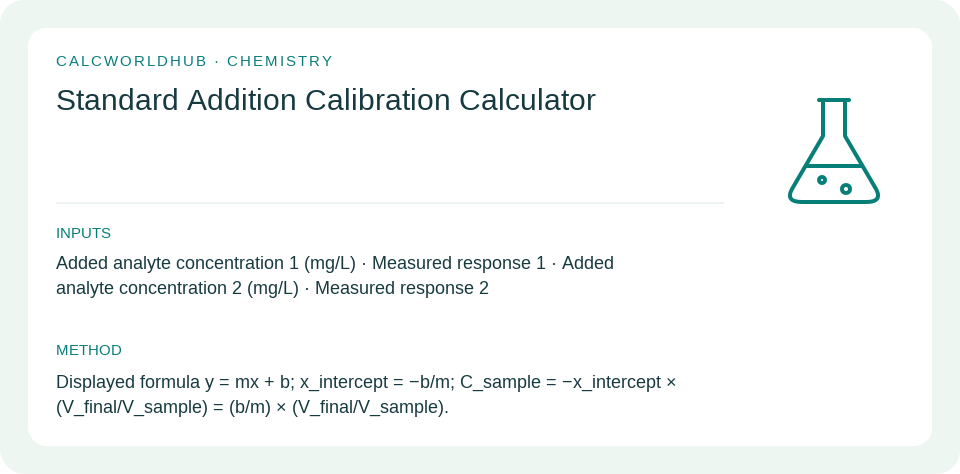
How to use this calculator
Estimate an unknown analyte concentration from a multi-point standard-addition calibration and the negative x-intercept.
- Enter Added analyte concentration 1 (mg/L), Measured response 1, Added analyte concentration 2 (mg/L), Measured response 2, then complete the remaining labeled fields. Match the units shown beside each field and review the result together with the assumptions below.
- Read the worked example below to check the expected input format and result.
- Compare another scenario by changing one input at a time. Use Reset to return to the starting values.
How this calculation works
Enter the added analyte concentration in each final calibration flask and the measured response. Include the unspiked sample as the zero-addition point. The least-squares line is extrapolated to zero response; its negative x-intercept estimates the analyte concentration in the diluted flask. Multiply by the final-flask-to-sample-aliquot dilution factor to recover concentration in the original sample.
Inputs and units
added0— Added analyte concentration 1 (mg/L)- Use zero for the unspiked sample response.
response0— Measured response 1- Instrument response for the first calibration flask.
added1— Added analyte concentration 2 (mg/L)- Added analyte concentration in the final flask after dilution.
response1— Measured response 2- Instrument response for the second calibration flask.
added2— Added analyte concentration 3 (mg/L)- Added analyte concentration in the final flask after dilution.
response2— Measured response 3- Instrument response for the third calibration flask.
added3— Added analyte concentration 4 (mg/L)- Added analyte concentration in the final flask after dilution.
response3— Measured response 4- Instrument response for the fourth calibration flask.
added4— Added analyte concentration 5 (mg/L)- Added analyte concentration in the final flask after dilution.
response4— Measured response 5- Instrument response for the fifth calibration flask.
dilutionFactor— Final flask volume ÷ sample aliquot volume- Use V_final / V_sample; enter 1 if the reported concentration is already on the original-sample basis.
Formula
y = mx + b; x_intercept = −b/m; C_sample = −x_intercept × (V_final/V_sample) = (b/m) × (V_final/V_sample).
Method
Fit an ordinary least-squares line to the entered added-analyte concentrations x and responses y. The magnitude of its negative x-intercept is the native analyte concentration in the final calibration flask. The entered dilution factor corrects it back to the original sample aliquot.
Worked example
With added concentrations 0, 4, 8, 12, and 16 mg/L and responses 4, 24, 44, 64, and 84, the fitted line is y = 5x + 4. Its negative x-intercept is 0.8 mg/L; a dilution factor of 2.5 gives an original-sample concentration of 2.0 mg/L.
Assumptions and limits
Assumes the response is linear over the entered range, all flasks use the same sample aliquot and final matrix volume, and the added concentrations are expressed in each final flask. Standard addition can reduce proportional matrix effects but does not remove additive background interference or nonlinear response. Use the procedure validated for your method.
Frequently asked questions
Why is the x-intercept negative?
The line is extrapolated backward to the added concentration that would reduce the modeled response to zero. Its magnitude estimates native analyte concentration in the final flask.
What should I enter for added concentration?
Enter the concentration contributed by the standard addition in each final calibration flask after dilution, in mg/L. The first point is the unspiked sample at zero.
When is standard addition useful?
It is commonly used when proportional matrix effects can change the instrument response. It does not correct additive background interference or a nonlinear response.
How do I use the Standard Addition Calibration Calculator?
Enter Added analyte concentration 1 (mg/L), Measured response 1, Added analyte concentration 2 (mg/L), Measured response 2, then complete the remaining labeled fields. Match the units shown beside each field and review the result together with the assumptions below.
What is a worked example of Standard Addition Calibration?
With added concentrations 0, 4, 8, 12, and 16 mg/L and responses 4, 24, 44, 64, and 84, the fitted line is y = 5x + 4. Its negative x-intercept is 0.8 mg/L; a dilution factor of 2.5 gives an original-sample concentration of 2.0 mg/L.
Reference: NIST air-density reference. See our calculation methodology.