How to use this calculator
Estimate theoretical dry-air demand per fuel mass from carbon, hydrogen, oxygen, and sulfur weight percentages.
- Enter Carbon in fuel (wt%), Hydrogen in fuel (wt%), Oxygen in fuel (wt%), Sulfur in fuel (wt%). Match the units shown beside each field and review the result together with the assumptions below.
- Read the worked example below to check the expected input format and result.
- Compare another scenario by changing one input at a time. Use Reset to return to the starting values.
How this calculation works
Fuel ultimate analysis can be converted into a theoretical air requirement for complete combustion. The calculation accounts for oxygen already present in the fuel and assumes carbon, hydrogen, and sulfur oxidize fully to CO₂, H₂O, and SO₂.
Inputs and units
carbonPct— Carbon in fuel (wt%)- Carbon mass as a percent of the analyzed fuel sample.
hydrogenPct— Hydrogen in fuel (wt%)- Hydrogen mass as a percent of the analyzed fuel sample.
oxygenPct— Oxygen in fuel (wt%)- Fuel-bound oxygen mass as a percent of the analyzed sample.
sulfurPct— Sulfur in fuel (wt%)- Sulfur mass as a percent of the analyzed fuel sample.
Formula
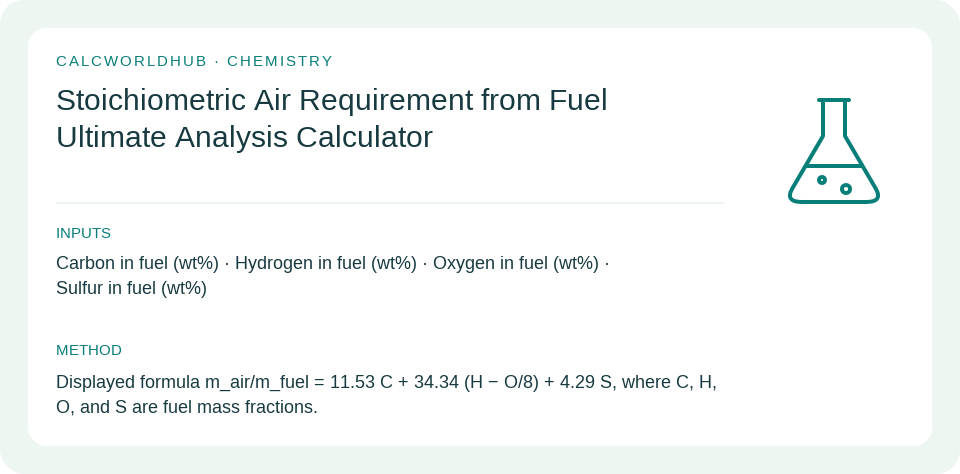
m_air/m_fuel = 11.53 C + 34.34 (H − O/8) + 4.29 S, where C, H, O, and S are fuel mass fractions.
Method
Enter carbon, hydrogen, oxygen, and sulfur as weight percentages of the same fuel sample. The calculator converts percentages to fractions and returns kilograms of theoretical dry air per kilogram of fuel.
Worked example
A fuel with 75 wt% carbon, 6 wt% hydrogen, 15 wt% oxygen, and 1 wt% sulfur has an estimated theoretical air requirement of 10.1069 kg air/kg fuel.
Assumptions and limits
Uses the EPA ultimate-analysis approximation for complete combustion with fixed dry-air composition. It excludes excess air, fuel moisture, ash and inert-gas corrections to combustion products, dissociation, incomplete combustion, and detailed fuel-species balancing. Do not use the result as an appliance or emissions-control set point.
Frequently asked questions
Why is fuel oxygen subtracted?
Oxygen already bound in the fuel reduces the amount of oxygen that must come from the air.
What does stoichiometric air mean?
It is the theoretical air mass for complete oxidation with no oxygen left over and no excess air.
Can this predict a burner setting?
No. Real burner operation depends on mixing, fuel properties, excess air, heat loss, control limits, and emissions constraints.
How do I use the Stoichiometric Air Requirement from Fuel Ultimate Analysis Calculator?
Enter Carbon in fuel (wt%), Hydrogen in fuel (wt%), Oxygen in fuel (wt%), Sulfur in fuel (wt%). Match the units shown beside each field and review the result together with the assumptions below.
What is a worked example of Stoichiometric Air Requirement from Fuel Ultimate Analysis?
A fuel with 75 wt% carbon, 6 wt% hydrogen, 15 wt% oxygen, and 1 wt% sulfur has an estimated theoretical air requirement of 10.1069 kg air/kg fuel.
Reference: U.S. EPA combustion-evaluation manual equation for stoichiometric air from fuel ultimate analysis. See our calculation methodology.