How to use this calculator
Predict the immediate contact temperature and penetration into two initially different-temperature solids.
- Enter Solid 1 conductivity (W/m/K), Solid 1 diffusivity (m²/s), Solid 1 initial temperature (°C), Solid 2 conductivity (W/m/K), then complete the remaining labeled fields. Match the units shown beside each field and review the result together with the assumptions below.
- Read the worked example below to check the expected input format and result.
- Compare another scenario by changing one input at a time. Use Reset to return to the starting values.
Sudden contact of two semi infinite solids explained
When two initially uniform solids make perfect thermal contact, their interface temperature is weighted by thermal effusivity. This ideal semi-infinite model then calculates the signed heat flux and temperatures at the entered depths; conductivity alone does not determine the interface temperature.
Inputs, symbols, and units
k1— Solid 1 conductivity (W/m/K)- Thermal conductivity of the first solid at the modeled condition, in W/(m·K).
a1— Solid 1 diffusivity (m²/s)- Positive thermal diffusivity of solid 1, in m²/s; together with conductivity it determines thermal effusivity.
T1— Solid 1 initial temperature (°C)- Uniform initial temperature of solid 1 before contact, in °C.
k2— Solid 2 conductivity (W/m/K)- Thermal conductivity of the second solid, in W/(m·K).
a2— Solid 2 diffusivity (m²/s)- Positive thermal diffusivity of solid 2 in m²/s, using properties consistent with its conductivity.
T2— Solid 2 initial temperature (°C)- Uniform initial temperature of solid 2 before contact, in °C.
t— Time since perfect contact (s)- Positive elapsed time after ideal contact, in seconds; the ideal t=0 flux is singular.
x1— Depth into solid 1 from interface (m)- Nonnegative depth measured from the interface into solid 1, in meters.
x2— Depth into solid 2 from interface (m)- Nonnegative depth measured from the interface into solid 2, in meters.
Formula and method
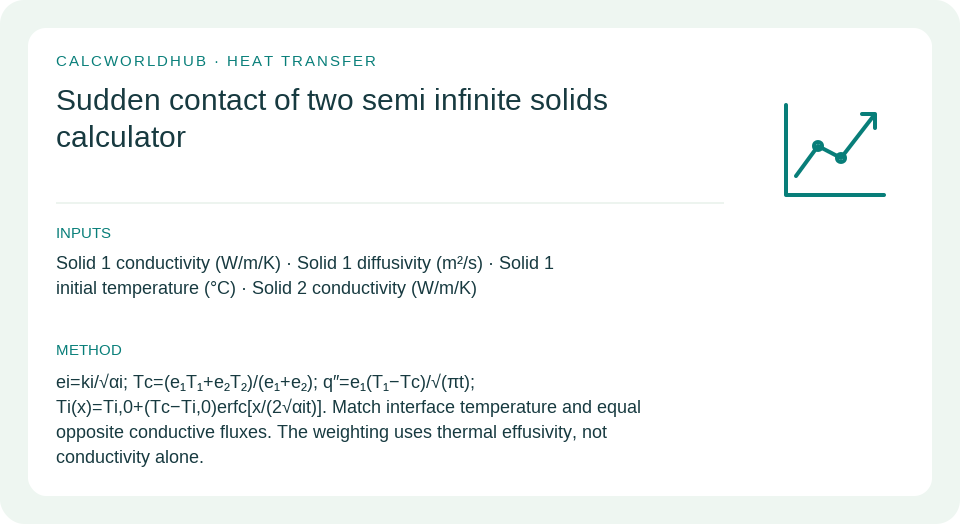
ei=ki/√αi; Tc=(e₁T₁+e₂T₂)/(e₁+e₂); q″=e₁(T₁−Tc)/√(πt); Ti(x)=Ti,0+(Tc−Ti,0)erfc[x/(2√αit)].
Match interface temperature and equal opposite conductive fluxes. The weighting uses thermal effusivity, not conductivity alone.
A worked scenario
Solid 1 conductivity (W/m/K) = 15; Solid 1 diffusivity (m²/s) = 0.000004; Solid 1 initial temperature (°C) = 100; Solid 2 conductivity (W/m/K) = 0.2; Solid 2 diffusivity (m²/s) = 1.00000000e-07; Solid 2 initial temperature (°C) = 20; Time since perfect contact (s) = 10; Depth into solid 1 from interface (m) = 0.005; Depth into solid 2 from interface (m) = 0.001.
- Common contact temperature: 93.778454 °C
- Heat flux from solid 1 to solid 2: 8325.007098 W/m²
- Temperature at depth in solid 1: 96.415456 °C
- Temperature at depth in solid 2: 55.376768 °C
A hot solid at 100 °C with k=15 and alpha=4e−6 touches a cooler solid at 20 °C with k=0.2 and alpha=1e−7 in SI units. The contact interface is 93.7785 °C, strongly weighted toward the first solid by its larger effusivity; flux after 10 s is 8,325.01 W/m².
Assumptions and edge cases
Perfect flat contact, two semi-infinite homogeneous bodies, constant properties and no contact resistance, phase change or external loss. The ideal flux diverges at t=0. Depth temperatures use a numerical error-function approximation; extra displayed decimal places are not a claim of matching physical or numerical accuracy. The reference-temperature fields and heat flux are calculated separately from that approximation.
Reading the outputs
Interface and depth temperatures are °C; positive flux moves from solid 1 to solid 2 in W/m².
Frequently asked questions
Why is the interface not the arithmetic mean?
Unequal thermal effusivities give unequal ability to absorb or release heat.
Does the contact temperature change with time?
Not in this special semi-infinite perfect-contact model; heat flux decreases as t to the minus one-half.
Can a thin coating be treated as semi-infinite?
Only before heat reaches its backing. Later response needs a finite layered model.
How do I use the Sudden contact of two semi infinite solids calculator?
Enter Solid 1 conductivity (W/m/K), Solid 1 diffusivity (m²/s), Solid 1 initial temperature (°C), Solid 2 conductivity (W/m/K), then complete the remaining labeled fields. Match the units shown beside each field and review the result together with the assumptions below.
What is a worked example of Sudden contact of two semi infinite solids?
Solid 1 conductivity (W/m/K) = 15; Solid 1 diffusivity (m²/s) = 0.000004; Solid 1 initial temperature (°C) = 100; Solid 2 conductivity (W/m/K) = 0.2; Solid 2 diffusivity (m²/s) = 1.00000000e-07; Solid 2 initial temperature (°C) = 20; Time since perfect contact (s) = 10; Depth into solid 1 from interface (m) = 0.005; Depth into solid 2 from interface (m) = 0.001. Common contact temperature: 93.778454 °C Heat flux from solid 1 to solid 2: 8325.007098 W/m² Temperature at depth in solid 1: 96.415456 °C Temperature at depth in solid 2: 55.376768 °C A hot solid at 100 °C with k=15 and alpha=4e−6 touches a cooler solid at 20 °C with k=0.2 and alpha=1e−7 in SI units.
Read our calculation methodology.