How to use this calculator
Find diametral taper, taper ratio, and lathe compound-rest angles from end diameters and taper length.
- Enter Large-end diameter (mm), Small-end diameter (mm), Taper length (mm). Match the units shown beside each field and review the result together with the assumptions below.
- Read the worked example below to check the expected input format and result.
- Compare another scenario by changing one input at a time. Use Reset to return to the starting values.
How this calculation works
A turned taper changes diameter along a specified axial length. The diametral taper is the end-diameter difference divided by taper length; a right-triangle relation gives the half-angle for a compound-rest setting.
Inputs and units
largeDiameter— Large-end diameter (mm)- Diameter at the larger end of the tapered section.
smallDiameter— Small-end diameter (mm)- Diameter at the smaller end of the tapered section.
taperLength— Taper length (mm)- Axial length over which the diameter changes.
Formula
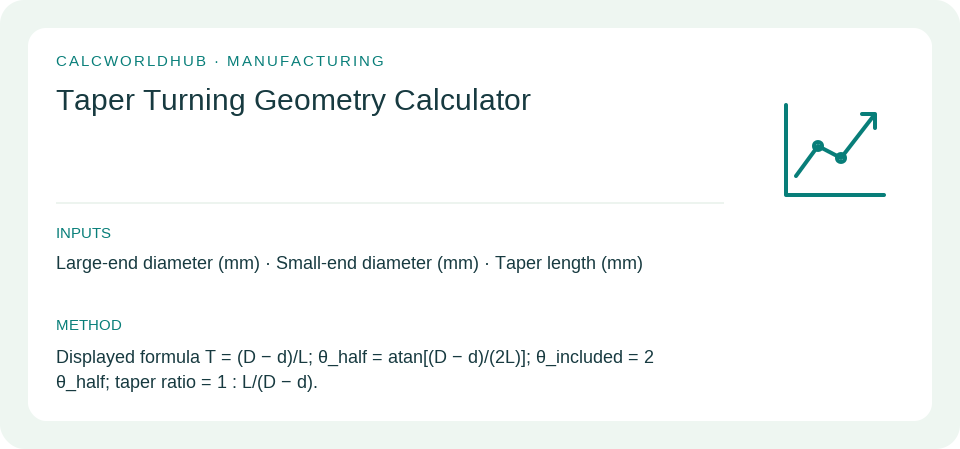
T = (D − d)/L; θ_half = atan[(D − d)/(2L)]; θ_included = 2 θ_half; taper ratio = 1 : L/(D − d).
Method
Enter the large-end diameter, small-end diameter, and tapered length in one consistent unit. The output angles are the included cone angle and the half-angle used for a compound-rest setup.
Worked example
For diameters 50 mm and 30 mm over 100 mm, diametral taper is 0.2000 mm/mm (1:5.000), the compound-rest half-angle is 5.7106°, and the included angle is 11.4212°.
Assumptions and limits
Assumes a straight circular cone and dimensions measured along the same axis and unit system. The compound-rest half-angle is a geometric setting; verify machine conventions and tool clearances before cutting. This does not calculate tailstock offset, tool deflection, or fit tolerances.
Frequently asked questions
Which angle is used on a manual lathe compound rest?
The compound rest is set to the half-angle between the cone surface and work axis.
What does taper 1:5 mean?
The diameter changes by one unit for every five units of axial length.
Do the dimensions need the same unit?
Yes. Use one unit for both diameters and the taper length; the ratio and angles then remain consistent.
How do I use the Taper Turning Geometry Calculator?
Enter Large-end diameter (mm), Small-end diameter (mm), Taper length (mm). Match the units shown beside each field and review the result together with the assumptions below.
What is a worked example of Taper Turning Geometry?
For diameters 50 mm and 30 mm over 100 mm, diametral taper is 0.2000 mm/mm (1:5.000), the compound-rest half-angle is 5.7106°, and the included angle is 11.4212°.
Reference: Carnegie Mellon machining formula appendix for calculating taper per inch and per foot. See our calculation methodology.