How to use this calculator
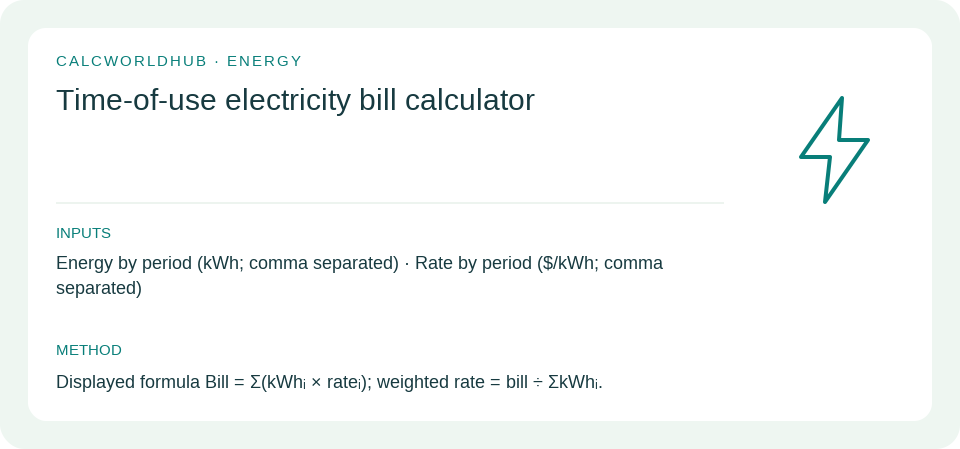
Estimate an electricity bill from energy used in separate tariff periods with different per-kWh rates.
- Enter Energy by period (kWh; comma separated), Rate by period ($/kWh; comma separated). Match the units shown beside each field and review the result together with the assumptions below.
- Read the worked example below to check the expected input format and result.
- Compare another scenario by changing one input at a time. Use Reset to return to the starting values.
How this calculation works
Splitting kWh by tariff period matters when peak, shoulder, and off-peak prices differ. Enter each period’s energy and rate to see the energy-only total and weighted rate.
Inputs and units
kwh— Energy by period (kWh; comma separated)- Enter matching nonnegative usage values for each tariff period.
rate— Rate by period ($/kWh; comma separated)- Enter one rate for each usage value, in the same order.
Formula
Bill = Σ(kWhᵢ × rateᵢ); weighted rate = bill ÷ ΣkWhᵢ.
Worked example
Using 180, 95, and 225 kWh at $0.34, $0.22, and $0.14/kWh gives $61.20 + $20.90 + $31.50 = $113.60 for 500 kWh.
Assumptions and limits
Energy-only estimate; excludes fixed charges, demand charges, taxes, tiered blocks, export credits, and tariff-specific rounding.
Frequently asked questions
Do periods have to match the utility tariff?
Yes. Group usage according to the tariff’s actual time windows.
Does the result include a demand fee?
No. Demand charges use peak kW and are calculated separately.
Can I enter more than three periods?
Yes, as long as the usage and rate lists have the same number of values.
How do I use the Time-of-use electricity bill calculator?
Enter Energy by period (kWh; comma separated), Rate by period ($/kWh; comma separated). Match the units shown beside each field and review the result together with the assumptions below.
What is a worked example of Time-of-use electricity bill?
Using 180, 95, and 225 kWh at $0.34, $0.22, and $0.14/kWh gives $61.20 + $20.90 + $31.50 = $113.60 for 500 kWh.
Read our calculation methodology.