How to use this calculator
Chain-link subperiod investment returns to estimate a cumulative time-weighted portfolio return.
- Enter Subperiod returns (%). Match the units shown beside each field and review the result together with the assumptions below.
- Read the worked example below to check the expected input format and result.
- Compare another scenario by changing one input at a time. Use Reset to return to the starting values.
How this calculation works
A time-weighted return compounds returns for consecutive subperiods, reducing the influence of the timing and size of external cash flows on the performance measure.
Inputs and units
periodReturnsPct— Subperiod returns (%)- Enter one percentage return for each consecutive subperiod; each value must be greater than −100%.
Formula
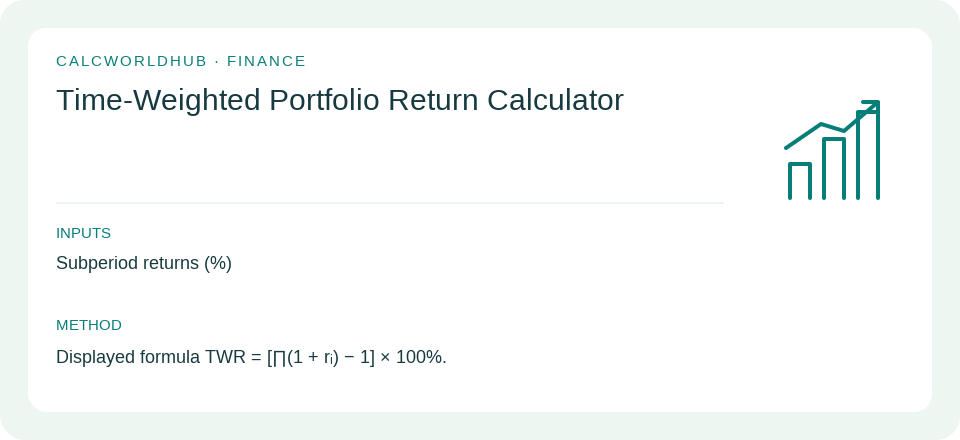
TWR = [∏(1 + rᵢ) − 1] × 100%.
Method
Enter each subperiod return as a percentage, separated by commas or spaces. The calculator converts each percentage to a growth factor, geometrically links the factors, and reports cumulative return and final growth multiple.
Worked example
Subperiod returns of 5%, −2%, and 3% chain-link to a cumulative time-weighted return of 5.99% and a growth multiple of 1.05987.
Assumptions and limits
This calculation assumes each entered return is a valid subperiod return with external cash flows handled through appropriate valuations. It is cumulative, not annualized, and does not calculate fees, taxes, benchmarks, or a return from raw cash flows.
Frequently asked questions
Why are subperiod returns geometrically linked?
Returns compound across time, so their growth factors are multiplied rather than added.
Does this remove external cash-flow timing?
When portfolio returns are measured between appropriately timed valuations, the chained result reduces the effect of investor-directed flows on the performance measure.
Is the result annualized?
No. It is the cumulative return across the entered subperiods; annualization requires the total measurement duration.
How do I use the Time-Weighted Portfolio Return Calculator?
Enter Subperiod returns (%). Match the units shown beside each field and review the result together with the assumptions below.
What is a worked example of Time-Weighted Portfolio Return?
Subperiod returns of 5%, −2%, and 3% chain-link to a cumulative time-weighted return of 5.99% and a growth multiple of 1.05987.
Reference: technical reference. See our calculation methodology.