How to use this calculator
Estimate tire tread wear per distance and project how far it may remain above a threshold you choose.
- Enter Earlier tread depth (mm), Current tread depth (mm), Distance between readings (km), Tread threshold for this estimate (mm). Match the units shown beside each field and review the result together with the assumptions below.
- Read the worked example below to check the expected input format and result.
- Compare another scenario by changing one input at a time. Use Reset to return to the starting values.
How this calculation works
This estimator compares two tread-depth measurements from the same tire with the odometer distance between them. It converts that observed change into a wear rate, then extends the rate linearly to a user-selected threshold. It is useful for planning a recheck or replacement, but tread wear can accelerate or vary across a tire.
Inputs and units
earlierDepthMm— Earlier tread depth (mm)- Depth measured before the odometer interval, at the same tire locations.
currentDepthMm— Current tread depth (mm)- Current reading from the same tire and comparable tread grooves.
distanceKm— Distance between readings (km)- Odometer distance driven between the two tread measurements.
thresholdMm— Tread threshold for this estimate (mm)- Set a local legal, vehicle, or personal planning threshold; the default is 1.6 mm.
Formula
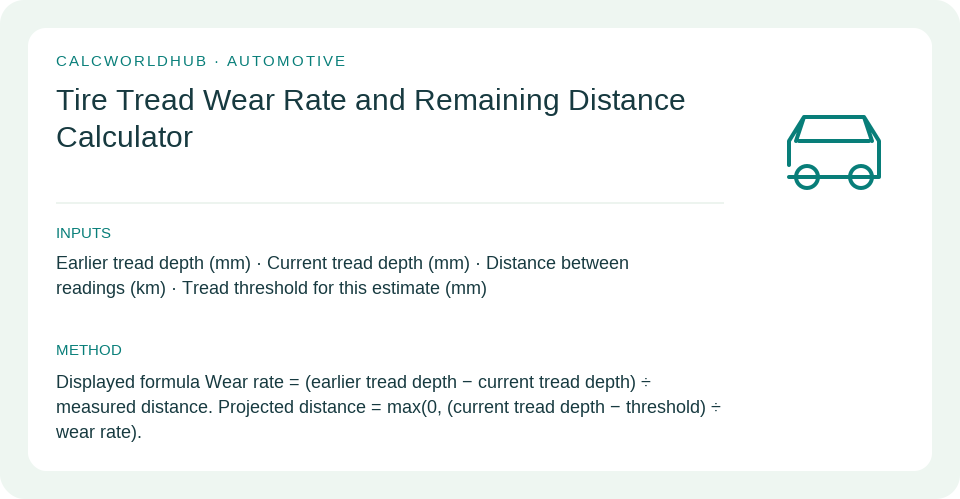
Wear rate = (earlier tread depth − current tread depth) ÷ measured distance. Projected distance = max(0, (current tread depth − threshold) ÷ wear rate).
Method
Use measurements taken at comparable positions and with the same gauge. The estimate treats average wear over the interval as constant; it does not infer tire condition from age, damage, alignment, or uneven wear.
Worked example
If tread decreases from 7.5 mm to 5.0 mm over 12,000 km, observed wear is 0.2083 mm per 1,000 km. With a 1.6 mm threshold, the linear projection is (5.0 − 1.6) ÷ (2.5 ÷ 12,000) = 16,320 km.
Assumptions and limits
The default 1.6 mm threshold corresponds to 2/32 inch, a U.S. NHTSA tire-safety threshold; laws, vehicle guidance, weather needs, and tire condition can call for earlier replacement. The projection is not a safety inspection. Replace or inspect damaged, cracked, bulging, or unevenly worn tires regardless of the estimate.
Frequently asked questions
How do I measure tread wear consistently?
Use the same tread-depth gauge and measure the same grooves across the tire at several positions. If the readings differ, assess the shallowest area rather than averaging away an unsafe spot.
Does this predict the exact tire replacement date?
No. It extrapolates one measured interval at a constant wear rate. Tire pressure, alignment, load, roads, driving, and wear patterns can change the rate.
Why is the default threshold 1.6 mm?
NHTSA identifies 2/32 inch (about 1.6 mm) as the minimum tread level at which tires should be replaced in its U.S. safety guidance. Follow local requirements and the tire or vehicle maker’s guidance.
What if current tread is already at or below the threshold?
The calculator returns zero projected distance. A zero estimate is not a substitute for inspection or a decision based on local rules and tire condition.
How do I use the Tire Tread Wear Rate and Remaining Distance Calculator?
Enter Earlier tread depth (mm), Current tread depth (mm), Distance between readings (km), Tread threshold for this estimate (mm). Match the units shown beside each field and review the result together with the assumptions below.
Reference: NHTSA tire safety guidance on tread depth and replacement. See our calculation methodology.