How to use this calculator
Calculate water TSS from the dried filter-residue mass and filtered sample volume.
- Enter Dry filter plus residue, A (mg), Clean filter tare, B (mg), Sample filtered, C (mL). Match the units shown beside each field and review the result together with the assumptions below.
- Read the worked example below to check the expected input format and result.
- Compare another scenario by changing one input at a time. Use Reset to return to the starting values.
How this calculation works
Enter the mass of the dried filter assembly with residue, the matching clean-filter tare, and the sample volume filtered. The result follows EPA Method 160.2 and is reported in mg/L.
Inputs and units
residuePlusFilterMg— Dry filter plus residue, A (mg)- Mass of the dried filter, or filter and crucible, with retained non-filterable residue.
filterTareMg— Clean filter tare, B (mg)- Mass of the same clean filter assembly before filtration.
sampleVolumeMl— Sample filtered, C (mL)- Volume of the original water sample passed through the filter.
Formula
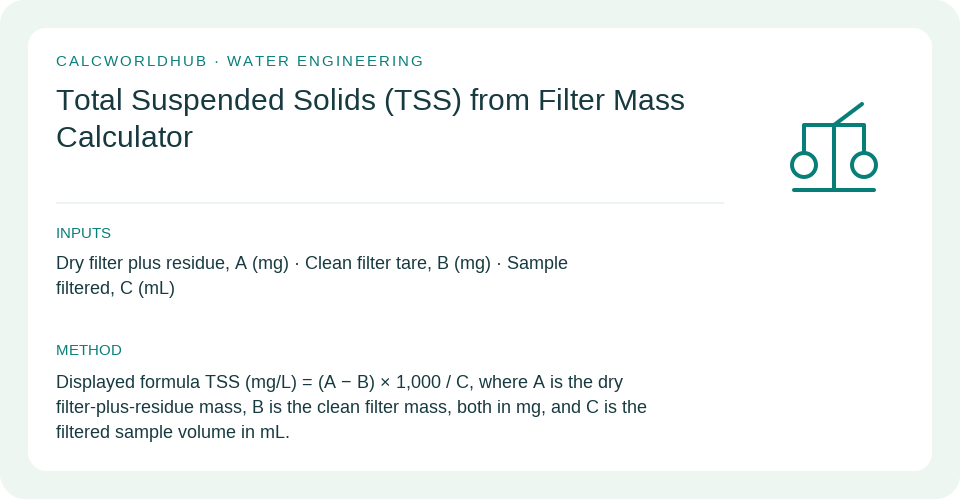
TSS (mg/L) = (A − B) × 1,000 / C, where A is the dry filter-plus-residue mass, B is the clean filter mass, both in mg, and C is the filtered sample volume in mL.
Method
Subtract the clean filter tare from the dried residue assembly to get retained solids in milligrams. Convert milliliters of sample to liters by multiplying the mass difference by 1,000 and dividing by the filtered volume.
Worked example
A dry filter assembly weighs 110 mg after filtration and drying; the clean filter tare is 100 mg, and 500 mL was filtered. TSS = (110 − 100) × 1,000 / 500 = 20 mg/L.
Assumptions and limits
This calculation assumes the filter assembly was dried and weighed using a consistent method and that the tare corresponds to that filter. EPA Method 160.2 defines non-filterable residue by filtration and drying at 103–105 °C. The calculator does not assess filter retention, sample representativeness, or constant-weight criteria.
Frequently asked questions
What does TSS measure?
Total suspended solids are the solids retained by the specified filter after the sample is filtered and the residue is dried.
Why is the filter tare subtracted?
The tare removes the filter assembly's own mass so only the retained sample residue contributes to the result.
Is TSS the same as turbidity?
No. TSS is a gravimetric mass concentration. Turbidity is an optical measurement and does not have a universal conversion to TSS.
How do I use the Total Suspended Solids (TSS) from Filter Mass Calculator?
Enter Dry filter plus residue, A (mg), Clean filter tare, B (mg), Sample filtered, C (mL). Match the units shown beside each field and review the result together with the assumptions below.
What is a worked example of Total Suspended Solids (TSS) from Filter Mass?
A dry filter assembly weighs 110 mg after filtration and drying; the clean filter tare is 100 mg, and 500 mL was filtered. TSS = (110 − 100) × 1,000 / 500 = 20 mg/L.
Reference: U.S. EPA Method 160.2 non-filterable residue gravimetric calculation. See our calculation methodology.