How to use this calculator
Estimate a maximum whole-share position from equity, risk budget, entry price, stop price, and round-trip fees.
- Enter Account equity ($), Planned risk (% of equity), Planned entry price ($/share), Stop price ($/share), then complete the remaining labeled fields. Match the units shown beside each field and review the result together with the assumptions below.
- Read the worked example below to check the expected input format and result.
- Compare another scenario by changing one input at a time. Use Reset to return to the starting values.
How this calculation works
Position sizing translates a chosen account-level risk budget into a number of shares for a planned stop distance. The calculation uses a fixed stop and entered transaction costs; it does not choose a trade or guarantee an execution price.
Inputs and units
equity— Account equity ($)- Value used only to calculate your chosen risk budget.
riskPercent— Planned risk (% of equity)- Choose your own risk allowance; no recommended percentage is implied.
entryPrice— Planned entry price ($/share)- Price used to estimate initial position value.
stopPrice— Stop price ($/share)- Planned stop level.
roundTripFee— Round-trip cost ($/share)- Estimated entry plus exit fees per share.
Formula
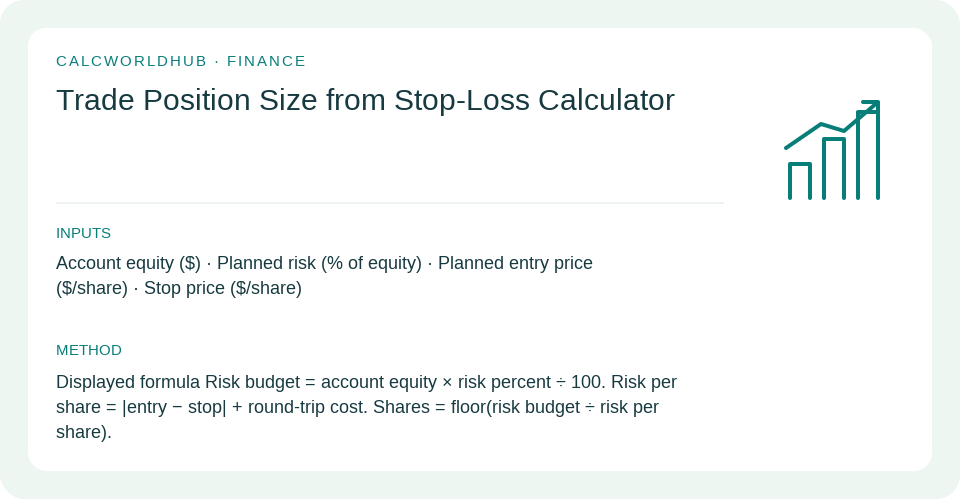
Risk budget = account equity × risk percent ÷ 100. Risk per share = |entry − stop| + round-trip cost. Shares = floor(risk budget ÷ risk per share).
Method
Enter account equity, the percentage you are willing to risk, entry and stop prices, and estimated round-trip fees per share. The share count is rounded down to a whole share.
Worked example
With $25,000 equity and a 1% risk budget, available risk is $250. A $50 entry, $48.50 stop, and $0.02 fee give $1.52 risk per share, so the estimate is 164 shares with $249.28 planned risk.
Assumptions and limits
Assumes a stop executes at the entered price; gaps, slippage, taxes, partial fills, leverage, and changing fees are excluded. This is a planning estimate, not investment advice.
Frequently asked questions
Does this guarantee my maximum loss?
No. Gaps, slippage, liquidity, and execution prices can make realized losses exceed the estimate.
Why round down the share count?
Rounding down keeps modeled stop loss at or below the stated budget under the fixed-price assumptions.
Can I use it for short trades?
Yes; the calculation uses the absolute entry-to-stop distance, but it does not check trade direction or suitability.
Does this include margin or options?
No. It does not model leverage, options, taxes, borrow fees, or total portfolio exposure.
How do I use the Trade Position Size from Stop-Loss Calculator?
Enter Account equity ($), Planned risk (% of equity), Planned entry price ($/share), Stop price ($/share), then complete the remaining labeled fields. Match the units shown beside each field and review the result together with the assumptions below.
Read our calculation methodology.