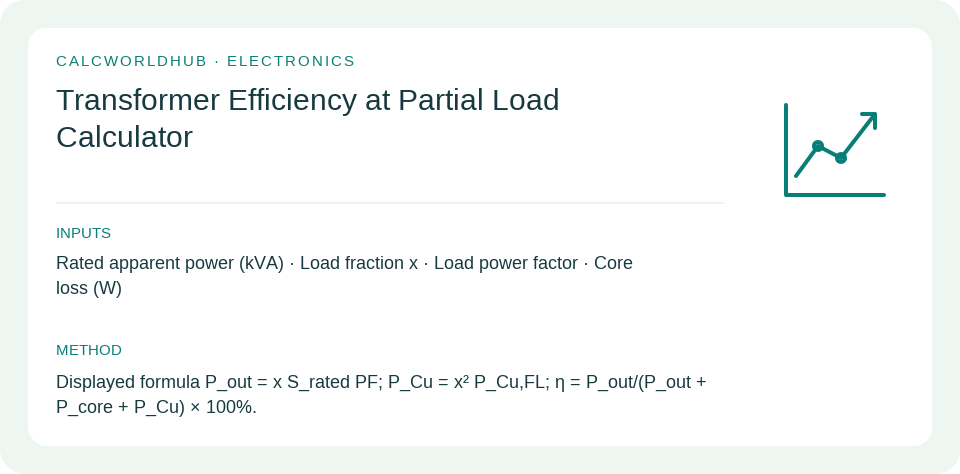
How to use this calculator
Estimate transformer efficiency at partial load from rated kVA, load power factor, core loss, and rated copper loss.
- Enter Rated apparent power (kVA), Load fraction x, Load power factor, Core loss (W), then complete the remaining labeled fields. Match the units shown beside each field and review the result together with the assumptions below.
- Read the worked example below to check the expected input format and result.
- Compare another scenario by changing one input at a time. Use Reset to return to the starting values.
How this calculation works
A transformer’s core loss is approximately constant at rated voltage and frequency, while winding copper loss varies with the square of load current. At a stated fraction of rated load, this calculator scales the full-load copper loss by the square of that fraction and compares output real power with output plus losses.
Inputs and units
ratedKva— Rated apparent power (kVA)- Enter the nameplate apparent-power rating.
loadFraction— Load fraction x- Enter actual apparent load divided by rated apparent load; values above 1 represent overload.
powerFactor— Load power factor- Use the magnitude of the real-power factor between 0 and 1.
coreLossW— Core loss (W)- Use the approximately constant no-load/core loss at rated voltage and frequency.
fullLoadCopperLossW— Full-load copper loss (W)- Enter winding copper loss measured or specified at rated current.
Formula
P_out = x S_rated PF; P_Cu = x² P_Cu,FL; η = P_out/(P_out + P_core + P_Cu) × 100%.
Method
Convert rated apparent power to kVA, multiply by load fraction x and power factor for real output kW. Scale rated full-load copper loss by x², add constant core loss, then calculate efficiency.
Worked example
For a 1,000 kVA transformer at x = 0.65 and PF = 0.90, with 3,000 W core loss and 10,000 W full-load copper loss, output is 585.0 kW, losses are 7.225 kW, and efficiency is 98.78%.
Assumptions and limits
Assumes voltage and frequency are near their rated values, core loss is constant, and copper loss follows current squared. It omits stray load, dielectric, auxiliary, temperature, waveform, and harmonic effects.
Frequently asked questions
Why does copper loss scale with load squared?
Winding copper loss is proportional to I²R; at fixed winding resistance, current scales approximately with load fraction.
Why is core loss treated as constant?
At a fixed voltage and frequency, magnetizing flux and core loss change much less with load than winding copper loss.
What load gives maximum efficiency in this simplified model?
Core and copper losses are equal at x = √(Pcore/Pcu,full-load), assuming the same rated voltage and frequency.
How do I use the Transformer Efficiency at Partial Load Calculator?
Enter Rated apparent power (kVA), Load fraction x, Load power factor, Core loss (W), then complete the remaining labeled fields. Match the units shown beside each field and review the result together with the assumptions below.
What is a worked example of Transformer Efficiency at Partial Load?
For a 1,000 kVA transformer at x = 0.65 and PF = 0.90, with 3,000 W core loss and 10,000 W full-load copper loss, output is 585.0 kW, losses are 7.225 kW, and efficiency is 98.78%.
Reference: U.S. Department of Energy Electrical Science Handbook transformer efficiency and core/copper losses. See our calculation methodology.