How to use this calculator
Compare a trapezoidal channel’s reach-mean boundary stress with a specified erosion or lining resistance.
- Enter Bed width (m), Side slope horizontal to vertical, Flow depth (m), Energy slope, then complete the remaining labeled fields. Match the units shown beside each field and review the result together with the assumptions below.
- Read the worked example below to check the expected input format and result.
- Compare another scenario by changing one input at a time. Use Reset to return to the starting values.
Trapezoidal channel boundary shear resistance margin explained
Use Bed width (m) with Side slope horizontal to vertical to reproduce the sample calculation, then review the stated limits before carrying the result into another scenario.
A numerical walkthrough
Bed width (m) = 3; Side slope horizontal to vertical = 2; Flow depth (m) = 1.2; Energy slope = 0.002; Specified permissible mean shear (Pa) = 12.
- Mean boundary shear: 15.190728 Pa
- Resistance minus shear: -3.190728 Pa
- Shear velocity: 0.123251 m/s
For b=3 m, 2H:1V sides, depth 1.2 m and energy slope 0.002, the hydraulic radius determines the mean boundary stress compared with a 12 Pa example resistance.
The model behind the numbers
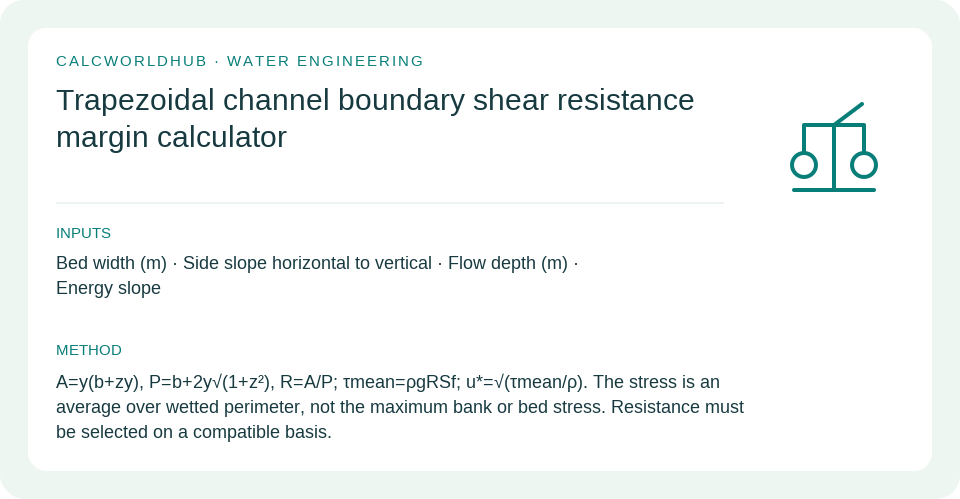
A=y(b+zy), P=b+2y√(1+z²), R=A/P; τmean=ρgRSf; u*=√(τmean/ρ).
The stress is an average over wetted perimeter, not the maximum bank or bed stress. Resistance must be selected on a compatible basis.
What to enter
b— Bed width (m)- Flat bottom width of the trapezoid.
z— Side slope horizontal to vertical- Horizontal side offset per unit vertical depth on each bank.
y— Flow depth (m)- Vertical water depth.
S— Energy slope- Friction energy gradient used to estimate reach-mean boundary stress.
tauc— Specified permissible mean shear (Pa)- An externally justified lining/soil resistance on the same average-shear basis.
Interpreting the result
Steady reach-average shear in water at 1000 kg/m³. Bends, local scour, bank stress concentration, vegetation and lining installation defects are not represented. Educational model; this is not a code-compliant design check.
Reading the outputs
Applied stress and remaining resistance margin are Pa; shear velocity is m/s.
Frequently asked questions
Is a positive margin proof against erosion?
No. Local peak shear and the applicability of the selected resistance remain critical.
Can the bed slope replace energy slope?
Only where the intended uniform-flow approximation makes them equal.
Why calculate shear velocity?
It is a turbulence/transport scale used in suspension and sediment models, not the mean channel velocity.
How do I use the Trapezoidal channel boundary shear resistance margin calculator?
Enter Bed width (m), Side slope horizontal to vertical, Flow depth (m), Energy slope, then complete the remaining labeled fields. Match the units shown beside each field and review the result together with the assumptions below.
What is a worked example of Trapezoidal channel boundary shear resistance margin?
Bed width (m) = 3; Side slope horizontal to vertical = 2; Flow depth (m) = 1.2; Energy slope = 0.002; Specified permissible mean shear (Pa) = 12. Mean boundary shear: 15.190728 Pa Resistance minus shear: -3.190728 Pa Shear velocity: 0.123251 m/s For b=3 m, 2H:1V sides, depth 1.2 m and energy slope 0.002, the hydraulic radius determines the mean boundary stress compared with a 12 Pa example resistance.
Background or definition reference: USACE HEC-RAS Hydraulic Reference Manual.
Reference access note: The linked HEC-RAS reference PDF was not retrievable during this review. The stated equation and numerical example were checked independently; verify against current official hydraulic guidance before design use.
Read our calculation methodology.