How to use this calculator
Explore how a nonuniform heated edge creates lateral as well as vertical conduction inside a rectangular plate.
- Enter Plate width (m), Plate height (m), Horizontal location from left edge (m), Vertical location from bottom edge (m), then complete the remaining labeled fields. Match the units shown beside each field and review the result together with the assumptions below.
- Read the worked example below to check the expected input format and result.
- Compare another scenario by changing one input at a time. Use Reset to return to the starting values.
Two dimensional plate sinusoidal boundary conduction explained
A sinusoidal temperature pattern along the top of a rectangular plate produces a separated steady-conduction solution. Temperature varies through the hyperbolic-sine factor, and heat flux follows the negative temperature gradient; conductivity scales flux without changing the specified-temperature solution.
Inputs, symbols, and units
W— Plate width (m)- Plate width in meters, measured along x.
H— Plate height (m)- Plate height in meters, measured along y.
x— Horizontal location from left edge (m)- Evaluation position from the left edge in meters, between zero and the plate width.
y— Vertical location from bottom edge (m)- Evaluation position above the bottom edge in meters, between zero and the plate height.
T0— Three-edge baseline temperature (°C)- Reference temperature of the bottom and side boundaries in °C.
amp— Top-edge sinusoidal temperature amplitude (K)- Signed top-boundary sinusoidal amplitude in °C relative to the reference temperature.
k— Plate conductivity (W/m/K)- Positive uniform thermal conductivity in W/(m·K); affects the two heat-flux outputs.
Formula and method
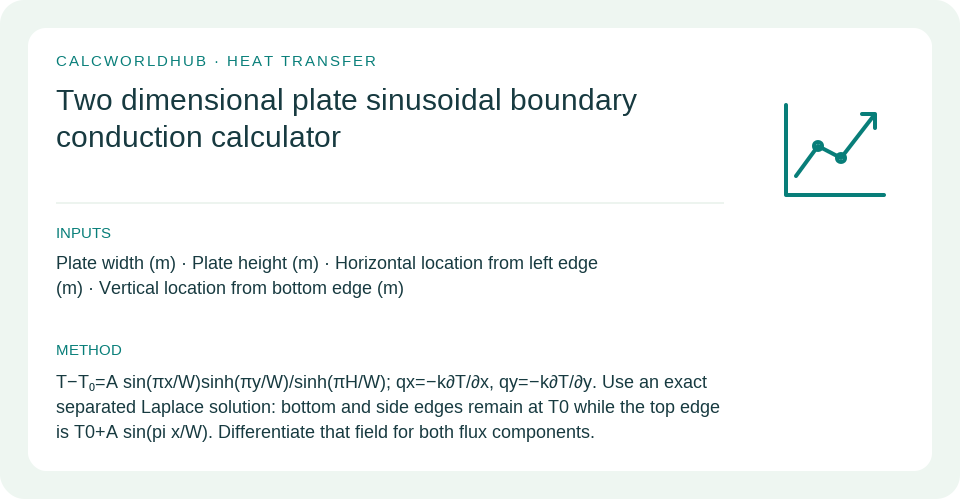
T−T₀=A sin(πx/W)sinh(πy/W)/sinh(πH/W); qx=−k∂T/∂x, qy=−k∂T/∂y.
Use an exact separated Laplace solution: bottom and side edges remain at T0 while the top edge is T0+A sin(pi x/W). Differentiate that field for both flux components.
A worked scenario
Plate width (m) = 0.4; Plate height (m) = 0.2; Horizontal location from left edge (m) = 0.2; Vertical location from bottom edge (m) = 0.1; Three-edge baseline temperature (°C) = 20; Top-edge sinusoidal temperature amplitude (K) = 80; Plate conductivity (W/m/K) = 15.
- Temperature at point: 50.197588 °C
- Horizontal heat flux: -2.17838309e-13 W/m²
- Vertical heat flux: -5424.826188 W/m²
A 0.4 by 0.2 m plate has a sinusoidal 80 K temperature departure along one edge over a 20 °C reference. At its center the solution is 50.1976 °C; symmetry makes x-direction flux zero there while y-direction flux is −5,424.83 W/m².
Assumptions and edge cases
Steady two-dimensional plate, no internal generation, constant conductivity and insulated front/back faces. The sinusoidal edge is a prescribed boundary, not a uniform top temperature.
Reading the outputs
Temperature is at the selected point; flux components are positive in increasing x and y directions.
Frequently asked questions
Why can horizontal heat flow exist?
The top edge is hotter near its middle than its corners, creating a lateral temperature gradient.
Does k change the temperature field?
Not for these prescribed boundary temperatures; it scales the heat flux components.
Can I use a uniformly hot top edge?
No. A uniform edge requires a Fourier sum rather than this single harmonic boundary.
How do I use the Two dimensional plate sinusoidal boundary conduction calculator?
Enter Plate width (m), Plate height (m), Horizontal location from left edge (m), Vertical location from bottom edge (m), then complete the remaining labeled fields. Match the units shown beside each field and review the result together with the assumptions below.
What is a worked example of Two dimensional plate sinusoidal boundary conduction?
Plate width (m) = 0.4; Plate height (m) = 0.2; Horizontal location from left edge (m) = 0.2; Vertical location from bottom edge (m) = 0.1; Three-edge baseline temperature (°C) = 20; Top-edge sinusoidal temperature amplitude (K) = 80; Plate conductivity (W/m/K) = 15. Temperature at point: 50.197588 °C Horizontal heat flux: -2.17838309e-13 W/m² Vertical heat flux: -5424.826188 W/m² A 0.4 by 0.2 m plate has a sinusoidal 80 K temperature departure along one edge over a 20 °C reference. At its center the solution is 50.1976 °C; symmetry makes x-direction flux zero there while y-direction flux is −5,424.83 W/m².
Read our calculation methodology.